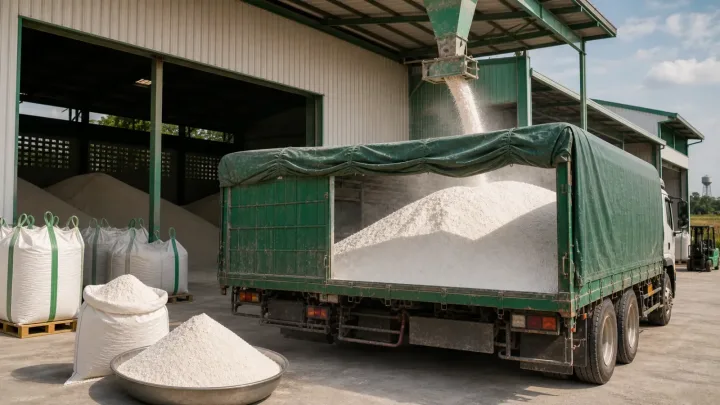
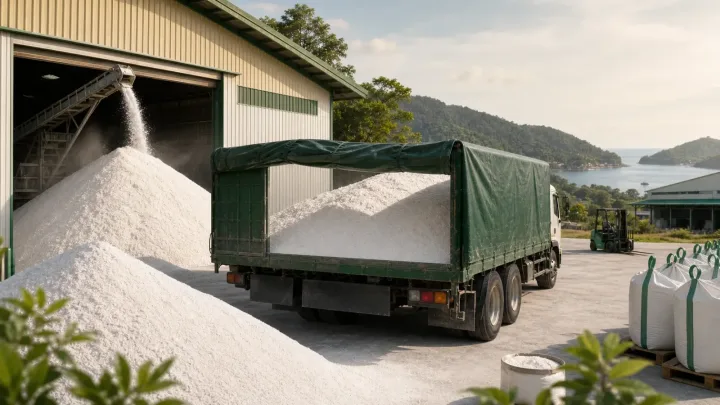
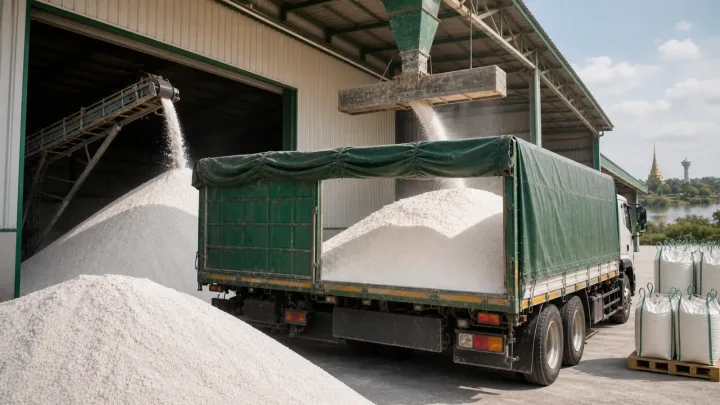
Pick Up at the Korat Warehouse vs. Delivered to Your Factory: Which Option Fits You?
By Sri Thong Admin · Published 2026-06-18 · Updated 2026-06-07
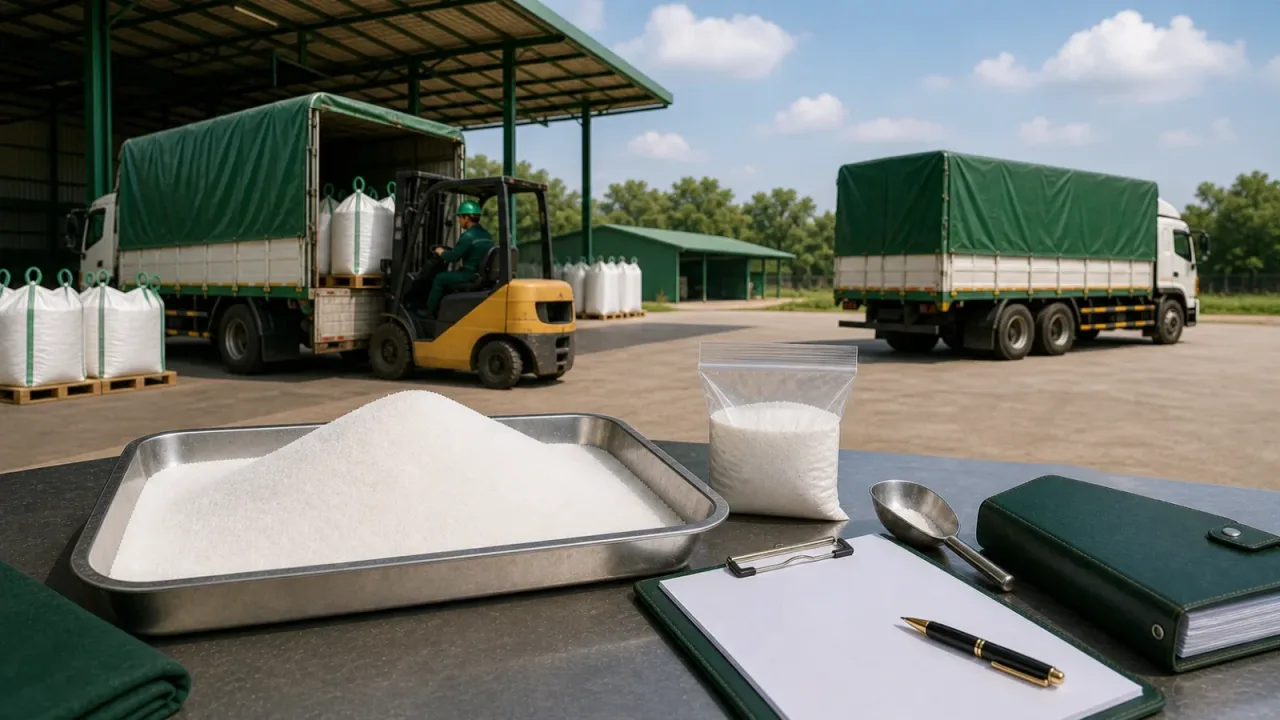
Summary of Logistics Cost Management Strategies for Animal Feed Raw Materials: Deciding Between Self-Pickup and Delivery Services
Choosing a logistics model for sourcing animal feed raw materials does not depend solely on the "unit price" of the goods; the key is managing the "Total Cost of Ownership" (TCO), which includes hidden transportation costs, the risk of damage during transit, and the efficiency of factory manpower. The decision between picking up goods yourself at a warehouse (e.g., warehouses in the Northeast/Korat region) versus using a delivery service to the factory requires an in-depth analysis between the ability to perform immediate quality control at the pickup point and the need to reduce warehouse management workloads, in order to create a competitive advantage in the animal feed manufacturing industry, where raw material costs are the most critical determinant of profit.
1. Introduction: Logistics Impact on Feed Cost Management
In the animal feed manufacturing industry, raw material costs often account for as much as 70-80% of total production costs. Therefore, managing unit price fluctuations (Feed Cost per Unit) is the ultimate challenge for entrepreneurs. However, what is often overlooked in cost calculations is "logistics costs," which is a key variable that can significantly alter a factory's profit structure.
Supply Chain management for livestock producers and feed mills is not just about finding the cheapest raw material source, but about managing supply continuity and controlling risks at every connection point—from moving goods from production sources and storage to delivery at the production line. If logistics management is inefficient, it will lead to hidden costs, such as product degradation due to improper transportation or loss of production opportunities due to inaccurate timing management.
2. Analysis: Self-Pickup Model - Korat Warehouse
The self-pickup model is often the choice for entrepreneurs who have ready vehicles and want to control initial raw material costs, especially when raw material sources are located in strategic points like Nakhon Ratchasima (Korat), which is the logistics hub of the Northeast.
Strategic Advantages
- Lower Product Unit Price: By removing the transportation service fee from the selling price, buyers can access the Ex-Warehouse Price, which is often lower than the price including delivery, helping to increase the margin for procurement budget management.
- Flexibility in Scheduling and Loading: Entrepreneurs can plan deliveries to align with the factory's own production plan, such as choosing available truck slots or prioritizing the loading sequence into the warehouse based on urgency.
- Immediate Quality Inspection: This is the core of B2B, as self-pickup allows Quality Control (QC) officers to immediately inspect packaging condition, bag integrity, or even request a Certificate of Analysis (COA) and check basic moisture levels at the warehouse before the container is sealed or the journey begins, reducing the risk of receiving goods that do not meet specifications.
Hidden Costs and Risks to Consider
- Transportation & Vehicle Depreciation: Beyond fuel costs, there are costs for vehicle maintenance, insurance premiums, and driver wages. If not fully calculated, the total cost may be found to be higher than using a delivery service.
- Labor and Opportunity Cost: The need to provide personnel to oversee loading and manage shipping documents is a use of human resources that could be applied to core business tasks.
- Risk of Transit Damage/Contamination: The risk of torn packaging, contamination from moisture in the container, or accidents during transit becomes the direct responsibility of the buyer.
3. Analysis: Delivery to Factory Model
The Door-to-Door Delivery model focuses on creating convenience and reducing operational complexity, making it suitable for factories that want to focus on increasing production efficiency.
Strategic Advantages
- Operational Efficiency & Time Saving: Reduces the logistics management workload within the factory, helping inventory turnover to proceed more smoothly.
- Risk Mitigation: Responsibility for damage during transport—whether from accidents, weather, or moisture—falls on the seller or the logistics provider, helping with loss prevention.
- Simplified Inventory Management: Receiving goods delivered directly to the unloading point allows for more accurate warehouse space planning according to scheduled delivery rounds.
Constraints and Considerations
- Price Premium & Shipping Fee Calculation: Buyers must consider whether the additional premium paid is worthwhile in business terms when compared to the convenience and risk reduction.
- Minimum Order Quantity (MOQ) Requirements: To ensure economic viability (Economies of Scale), providers often set an MOQ, which may affect the buyer's cash flow management.
- Dependency on Supplier’s Logistics Capability: If the seller faces issues with fleet management or experiences logistics problems, it may impact the factory's production plan.
4. Decision Matrix: Deep Dive Comparison
| Dimension | Self-Pickup Model | Delivery Model |
|---|---|---|
| Total Cost of Ownership | Lower unit price, but has hidden transportation and labor costs. | Higher unit price (including service), but easier to control the budget. |
| Risk Management | The buyer assumes the risk of damage and contamination during transit. | The risk of transportation lies with the seller/provider. |
| Quality Control | Very High (can inspect goods and COA before warehouse entry). | Moderate (relies on trust and inspection upon arrival at the destination). |
| Labor/Admin Management | Requires human resources and time to manage vehicles and documentation. | Reduces logistics management workload (Outsourced Logistics). |
| Scalability | Suitable for uncertain volumes or using small/own vehicles. | Suitable for bulk orders to achieve economies of scale. |
5. Conclusion: The Decision Framework
The decision between these two models has no single "best" answer for everyone; it depends on the cost structure and the management capabilities of each organization.
Checklist for Small/Medium Farms: When is Self-Pickup more worthwhile?
- You have ready-to-use vehicles with fixed travel schedules.
- You need close quality control (Sensitive Raw Materials).
- You want to manage Cash Flow by purchasing at ex-warehouse prices to manage the difference yourself.
- Order quantities are irregular, making regular delivery difficult.
Checklist for Large Farms/Processing Plants: When is Delivery the best answer?
- You want to focus on production efficiency (Focus on Core Production) and reduce non-core tasks.
- You have high and stable order volumes (High Volume & Stability) that meet MOQ requirements.
- You want to reduce the risk of product loss during transport (Risk Mitigation).
- You require precision in warehouse management (Just-in-Time Inventory Management).
Expert Advice
In long-term supply chain planning, entrepreneurs should develop a hybrid strategy by periodically assessing fluctuations in raw material and fuel prices. Forward planning, combined with negotiating flexible delivery terms with the supplier, will help sustainably reduce the volatility of feed costs. If you require additional technical information regarding product specifications, COA test results, or wish to request a quotation for bulk orders for accurate cost calculation, you can contact our sales department for immediate consultation.
Sources
- Thai Tapioca Starch Association - Tapioca Production - https://www.thaitapiocastarch.org/en/information/statistics/tapioca_production - ใช้ยืนยันภาพรวมผลผลิตมันสำปะหลังไทยและบริบท supply ของอุตสาหกรรม
- Thai Tapioca Starch Association - Export Tapioca Products - https://www.thaitapiocastarch.org/en/information/statistics/export_tapioca_products - ใช้ยืนยันสถิติส่งออกผลิตภัณฑ์มันสำปะหลัง รวมถึงหมวด Pulp
- Thai Tapioca Starch Association - Tapioca Starch Processing - https://thaitapiocastarch.org/en/information/learning_industry/tapioca_starch_processing - ใช้อธิบายกระบวนการผลิตแป้งมันและที่มาของผลพลอยได้จากโรงงานแป้งมัน
- ACFS / TAS 8803-2561 - มาตรฐานสินค้าเกษตร กากมันสำปะหลัง - https://www.opsmoac.go.th/udonthani-dwl-files-471491791858 - ใช้อ้างอิงนิยามกากมันสำปะหลังแห้ง/ผง/อัดเม็ด และข้อกำหนดพื้นฐาน เช่น ไม่พบเชื้อราหรือสิ่งแปลกปลอมที่มองเห็นได้
- GP Autoparts - Truck Law 2024 - https://www.gpautoparts.co.th/en/truck-law-2024-latest-regulations-and-penalties-that-truck-owners-need-to-know/ - ใช้ประกอบข้อจำกัดน้ำหนักรถบรรทุก เช่น 10 ล้อ 25 ตัน เพื่ออธิบาย full truck load
- Google Maps - https://www.google.com/maps - ใช้เป็นแหล่งตรวจระยะทางจริงก่อนเผยแพร่บทความจังหวัด เพราะระยะทางเปลี่ยนตามจุดเริ่มต้นและเส้นทาง
- Department of Land Transport - https://www.dlt.go.th/ - ใช้เป็นแหล่งอ้างอิงหน่วยงานกำกับดูแลการขนส่งทางบกเมื่อต้องตรวจข้อกำหนดล่าสุด

Author information
Sri Thong Admin
B2B dried cassava pulp content specialist
Affiliation
SRITHONG PRODUCTTAPIOCA COMPANY LIMITED