How to Check Moisture in Dried Cassava Pulp Before Receiving Goods
By Sri Thong Admin · Published 2026-06-11 · Updated 2026-06-07
Executive Summary: The Core Essentials of Moisture Control in Dried Cassava Pulp
Controlling the moisture levels in Dried Cassava Pulp is a strategic decision-making process that directly impacts raw material costs and the quality of finished animal feed. Receiving goods with moisture levels exceeding standards is not merely paying for "water" instead of "dry matter"; it also brings massive risks of fungal contamination and mycotoxins, which undermine the credibility of feed formulas and production standards. Therefore, implementing representative sampling procedures and utilizing precise analytical methods—both rapid on-site testing and standard reference methods—is essential. This enables factories to make accurate decisions regarding product acceptance, price adjustments based on moisture proportions, or product rejection, in order to maintain the highest quality standards of the feed mill.
1. The Technical Importance of Moisture Control in Dried Cassava Pulp
In the animal feed industry, moisture content is not just a figure representing water within the raw material, but a critical variable that controls all chemical and physical properties of the product.
Impact on Nutritional Value and Energy Content:
Dried cassava pulp is a source of carbohydrates and energy. As moisture increases, the proportion of dry matter decreases, leading to inaccuracies in Least Cost Formulation. If the factory calculates based on the nutrient values specified in the specification, but the actual moisture is higher than prescribed, animals will not receive the intended levels of energy and nutrients.
Food Safety Risk:
Moisture levels exceeding standard thresholds (generally should not exceed 12-14%, depending on the agreement) are the primary driver for fungal growth, particularly the Aspergillus flavus group, which produces Aflatoxin. This contamination is not visible to the naked eye in its early stages but can cause damage to animal health and potentially impact consumer safety within the food chain.
Economic & Storage Impact:
High moisture facilitates easier fermentation of raw materials, resulting in a reduced shelf-life when stored in silos or warehouses. It also increases the risk of caking, which creates operational issues for the feed mill's conveying systems.
2. Pre-Inspection Preparation
Effective inspection does not begin with measurement, but with the preparation of the operational system.
Calibration & Equipment Check:
All moisture measurement instruments must undergo scheduled calibration. Furthermore, verification against standard substances or comparison with a reference instrument should be performed before the actual inspection begins to prevent deviations caused by the equipment itself.
Sampling Tools:
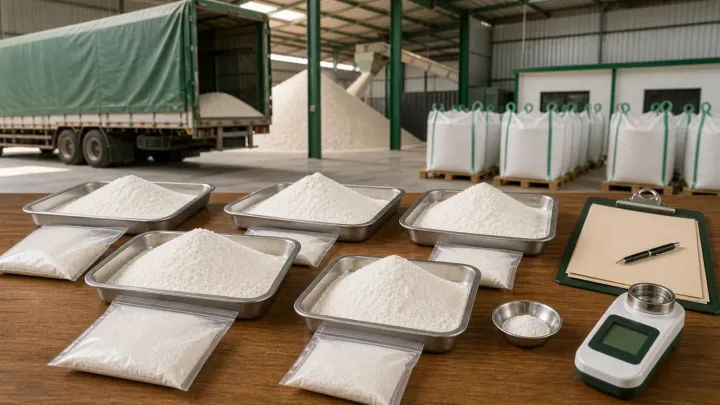
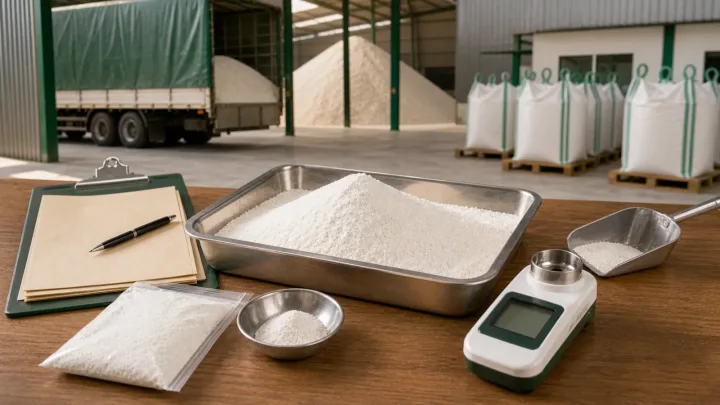
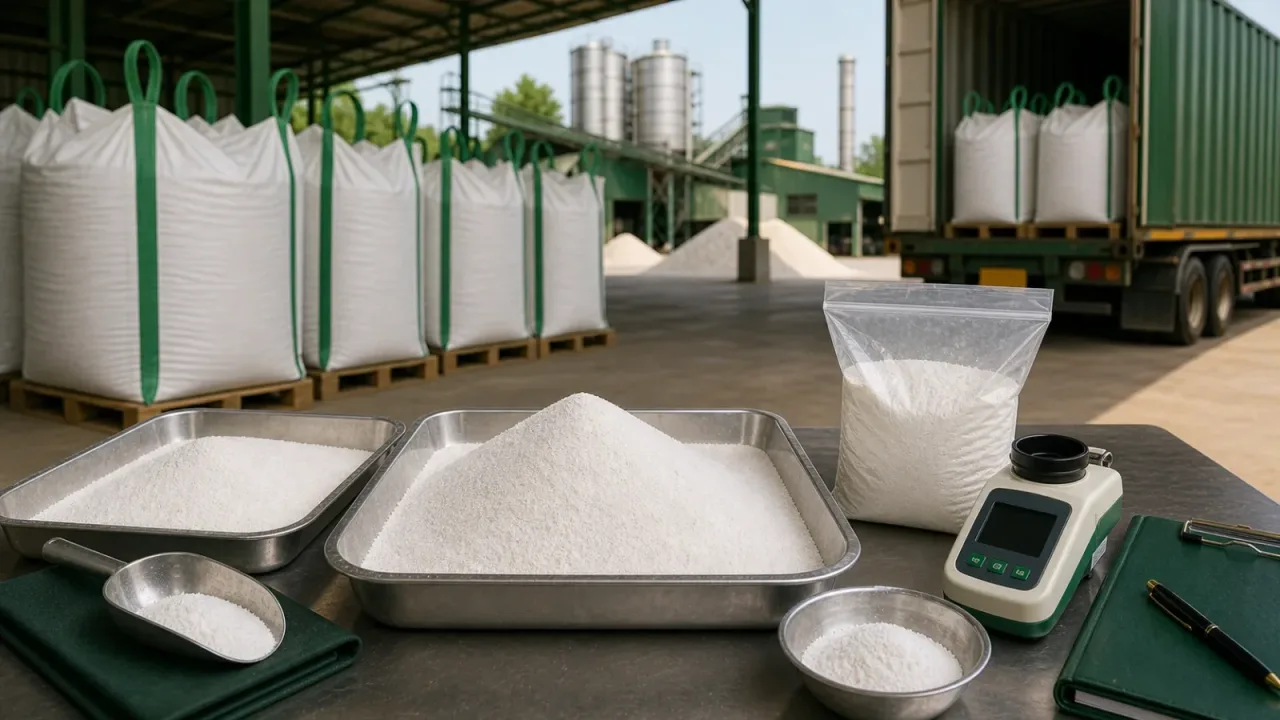
Tools must be clean and free from cross-contamination. Essential equipment includes a sampler/trier for penetrating the layers of the raw material, sample bags that can be hermetically sealed to prevent moisture from evaporating into the external air, and containers for creating a composite sample.
Acceptance Criteria/Specification:
The Quality Control (QC) team must have clear specification documents stating the maximum allowable moisture limit in accordance with the purchase agreement. This serves as a fair decision-making criterion for both the buyer and the seller.
3. Representative Sampling Protocol
The most common problem in QC work is "Sampling Error," where the collected sample fails to reflect the true condition of the entire shipment in the truck.
Random Sampling:
It is crucial to avoid selecting only easily visible spots or parts that appear to be of good quality. Sampling must follow statistical principles to ensure that every part of the product has an equal opportunity to be sampled.
Stratified Sampling:
Since moisture may stratify in trucks or sacks (due to surface evaporation or moisture accumulation at the bottom), inspectors must collect samples from different positions, namely the Top, Middle, and Bottom of the lot.
Composite Sampling:
After obtaining sub-samples from all positions, they should be mixed thoroughly in a clean container before a portion is taken for analysis. This method helps reduce error and creates an average value that truly represents the entire lot.
4. Moisture Analysis Methods
The choice of analytical method depends on the required speed and precision for the application.
| Analysis Method | Working Principle | Key Strengths | Precautions |
| Halogen Moisture Analyzer | Loss on Drying (LOD) using heat and halogen radiation | Fast (5-15 minutes); ideal for daily QC work | Potential loss of other volatile matter if the temperature is too high |
| Hot Air Oven | Gravimetric Method (weighing before and after drying) | Reference Method; high precision | Time-consuming (several hours) and requires strict condition control |
| Handheld Meter | Infrared / Microwave / Capacitance | Easy for field use; suitable for initial screening | Lower precision than other methods; used for screening only |
Method 1: Halogen Moisture Analyzer
This is the most popular method in feed mills due to its rapid results, based on the Loss on Drying (LOD) principle, which measures the weight loss from evaporation.
- Key Step: Prior to analysis, the sample should be ground to an appropriate particle size to increase the surface area for evaporation, thereby improving measurement accuracy.
- Control: The temperature must be set appropriately; if it is too high, other volatile matter may be lost along with the water, leading to an overestimation of the moisture content.
Method 2: Hot Air Oven Method
This is the standard Reference Method (such as ISO or AOAC) used for verification.
- Key Step: It uses the Gravimetric Method by weighing the sample before drying and weighing it after drying until a constant weight is achieved.
- Control: Temperature and drying duration must be controlled according to standards to ensure that all water is evaporated without causing charring or chemical changes in the sample.
Method 3: Rapid Moisture Meter (Infrared/Handheld)
Suitable for field use, such as preliminary checks at the factory gate or receiving area.
- Usage: Used as a screening tool to decide whether a truck should proceed to the detailed inspection process.
- Limitations: Accuracy may vary based on environmental conditions; it should not be used as a reference value for financial documentation or price adjustments.
5. Data Interpretation & Decision Making
Once the moisture values are obtained, the next step is to utilize the data for business decision-making.
Error Analysis:
When receiving large quantities of goods, the Standard Deviation should be calculated to assess product consistency. If the values from multiple samplings vary excessively, it may indicate poor sampling techniques or high product heterogeneity.
Pass/Fail Criteria:
Decisions are made based on the specifications agreed upon in the purchase contract (e.g., moisture not exceeding 13.0% w/w).
Action Plan for Non-conforming Goods:
Price Adjustment: In cases where moisture slightly exceeds the limit but remains within a safe level, using a Weight Correction method to adjust the price proportionally to the excess water is a way to maintain supplier relationships and minimize losses.Rejection: If moisture is found to be at a critical level or if there are signs of mold/unusual odors, the factory should have the authority to reject the shipment immediately.Re-sampling: If the results are ambiguous or if there is a dispute between the buyer and seller, it should be agreed that a new sample be taken using a Reference Method to ensure fairness.
6. Error Sources & Troubleshooting
Errors in moisture measurement often do not stem from the instrument alone, but from environmental factors and management.
7. Conclusion & Best Practices for Standard Development
Quality control of dried cassava pulp is not merely a task of inspecting goods, but is about building a sustainable system for the Supply Chain Sustainability. Leading feed mills should upgrade from paper-based records to Digital Traceability systems, enabling the tracking of raw material origins when quality issues arise.
Additionally, conducting regular Vendor Audits—inspecting the production and storage processes of suppliers—will help the factory control quality at the source, reduce the burden of on-site inspections, and ensure that every ton of raw material entering the factory truly meets the established quality standards.
Sources
- Thai Tapioca Starch Association - Tapioca Production - https://www.thaitapiocastarch.org/en/information/statistics/tapioca_production - ใช้ยืนยันภาพรวมผลผลิตมันสำปะหลังไทยและบริบท supply ของอุตสาหกรรม
- Thai Tapioca Starch Association - Export Tapioca Products - https://www.thaitapiocastarch.org/en/information/statistics/export_tapioca_products - ใช้ยืนยันสถิติส่งออกผลิตภัณฑ์มันสำปะหลัง รวมถึงหมวด Pulp
- Thai Tapioca Starch Association - Tapioca Starch Processing - https://thaitapiocastarch.org/en/information/learning_industry/tapioca_starch_processing - ใช้อธิบายกระบวนการผลิตแป้งมันและที่มาของผลพลอยได้จากโรงงานแป้งมัน
- ACFS / TAS 8803-2561 - มาตรฐานสินค้าเกษตร กากมันสำปะหลัง - https://www.opsmoac.go.th/udonthani-dwl-files-471491791858 - ใช้อ้างอิงนิยามกากมันสำปะหลังแห้ง/ผง/อัดเม็ด และข้อกำหนดพื้นฐาน เช่น ไม่พบเชื้อราหรือสิ่งแปลกปลอมที่มองเห็นได้
- FAO - Roots, tubers, plantains and bananas in animal feeding - https://www.fao.org/4/T0554E/T0554E05.htm - ใช้ยืนยันประเด็นความชื้น สิ่งปลอมปน เถ้า ทราย และความเสี่ยง aflatoxin ในสินค้า cassava/feed
- FAO - Thailand Feed and Feed Ingredient Standards - https://www.fao.org/fileadmin/user_upload/affris/docs/standard/Thailand_Feed_and_Feed_Ingredient_Standards.pdf - ใช้เป็นตัวอย่างโครงสร้างค่าวิเคราะห์วัตถุดิบอาหารสัตว์ เช่น moisture, protein, fiber, ash
- DLD - การตรวจอะฟลาทอกซินในวัตถุดิบอาหารสัตว์ - https://qcontrol.dld.go.th/images/Prototype/knowledge/analysis/2565/13.pdf - ใช้สนับสนุนหัวข้อ aflatoxin, วิธีวิเคราะห์ และเหตุผลที่ควรตรวจเป็นรอบเมื่อมีความเสี่ยง

Author information
Sri Thong Admin
B2B dried cassava pulp content specialist
Affiliation
SRITHONG PRODUCTTAPIOCA COMPANY LIMITED