Buying a Full Truckload of Dried Cassava Pulp (25–30 Tons): What You Need to Know
By Sri Thong Admin · Published 2026-06-07 · Updated 2026-06-07
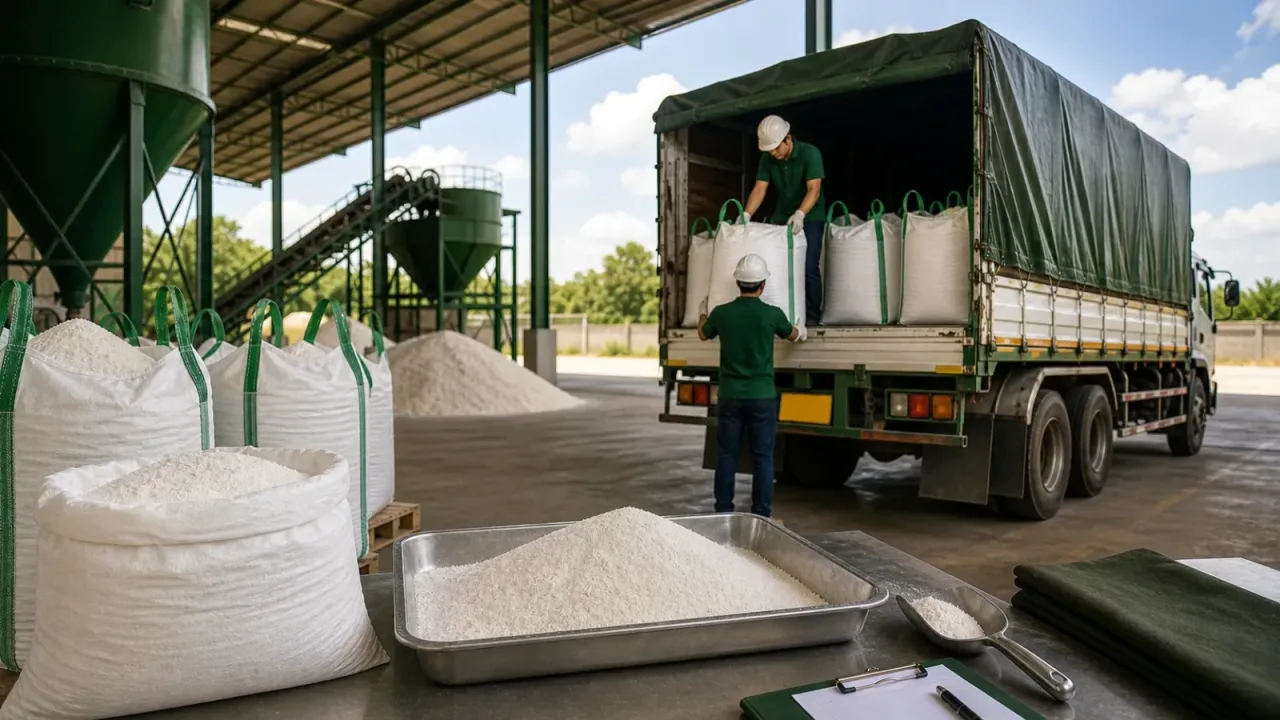
Key Summary for Bulk Cassava Pulp Procurement (25-30 Tons)
Managing bulk procurement of cassava pulp (25-30 tons per trip) for use in feed mills should not rely solely on the "price per ton" offered. The critical focus for procurement officers and animal nutritionists must be on controlling Moisture Content to calculate the true Dry Matter (DM) value, inspecting Impurities to prevent contamination, and ensuring accurate Net Weight to avoid hidden costs arising from weight loss during transport or "buying water" instead of "buying nutrients." These factors directly impact the Feed Conversion Ratio (F/CR) and the overall economic viability of the production process.
1. Strategic Importance of Using Cassava Pulp in Feed Formulations
In the animal feed industry, Cassava Pulp serves as a vital energy source, particularly as a carbohydrate source to replace more expensive raw materials, such as corn. Effectively utilizing cassava pulp is therefore a primary strategy for Feed Cost Reduction, which accounts for 60-70% of total animal production costs.
However, transitioning from small-scale orders to bulk purchasing (25-30 tons per trip) brings significant risk management challenges. If Quality Assurance processes are not sufficiently rigorous, the factory faces the risk of receiving inconsistent raw materials, which impacts formulation stability and can lead to higher-than-expected costs due to nutrient levels falling below specifications.
2. Nutritional & Physical Quality Control
The quality control of cassava pulp must be systematic, focusing on three main factors:
Moisture Content: The Most Critical Variable in Cost Calculation
Moisture is the variable with the greatest impact on both price and quality. In a 30-ton purchase, if moisture exceeds the agreed standard by just 3%, the factory is essentially paying for nearly 1 ton of water instead of feed (Buying Water vs. Buying Feed). Furthermore, excessive moisture is a major catalyst for mold growth, particularly Aflatoxin contamination, which is hazardous to animals and can damage the credibility of the final feed products.
Starch and Fiber Content
The efficiency of cassava pulp depends on the remaining starch content. If the upstream starch production process removes too much starch, the remaining pulp will have high fiber content. If fiber levels exceed the formulation limits, it will directly affect the Average Daily Gain (ADG) and worsen the Feed Conversion Ratio (FCR), as animals cannot fully digest and utilize the energy.
Contamination & Physical Impurities
Inspecting physical impurities such as sand, grit, or cassava peels is essential. These not only provide no nutritional value but can also cause damage to the factory's processing machinery, such as the Hammer Mill. Additionally, vigilance is required regarding chemical residues from the starch production process that may be present in the pulp.
3. Weight & Volume Management
The issue of "weight discrepancies" is a classic challenge in bulk agricultural trading.
Weight Verification
The receiving process must utilize Gross Weight (total weight of truck and product) minus Tare Weight (weight of the empty truck) to determine the true Net Weight. Factories should ensure that both the supplier's and the factory's scales are properly calibrated and up-to-date to prevent disputes regarding weight loss.
Bulk Density and Transportation Loss
Cassava pulp exhibits different bulk densities across different lots. A truck appearing less than full may not necessarily mean a shortage in weight, but could result from changes in material density. However, buyers must remain vigilant regarding "Shrinkage" caused by moisture evaporation during transit or product leakage between the production site and the factory.
4. Cost-Effectiveness Analysis
The best price comparison is not found by looking at the Price per Ton, but by looking at the price per unit of dry nutrient.
Price per Dry Matter (DM) Calculation
The most accurate comparison formula is calculating the Price per DM to reveal the true cost of the energy received. For example, if Lot A is priced at 8,000 THB/ton (12% moisture) compared to Lot B at 7,800 THB/ton (15% moisture), calculating the weight back to Dry Matter (DM) might reveal that Lot A is more cost-effective nutritionally.
Assessment of Hidden Costs
Buyers must consider the logistics cost per ton and the opportunity cost in cases where raw materials degrade before use. Choosing a cheaper supplier with long transport distances or poor logistics management can lead to higher costs due to quality risk management.
5. Risk & Logistics Management
Establishing standardized receiving procedures is the best shield against risk.
Acceptance Criteria
Factories should have clear Rejection Criteria. For instance, if moisture is detected above 15% or impurities exceed the standard at the farm or factory gate, receiving staff must have the authority to halt unloading to prevent damage to the warehouse inventory.
Storage & Inventory Management
Managing 30 tons of cassava pulp requires proper warehouse management. Controlled ventilation is necessary to reduce heat accumulation that could lead to spoinsage, alongside measures to prevent cross-contamination from other raw materials and pest control to protect the quality of the material.
6. Summary & Buyer’s Checklist
Building sustainable relationships with suppliers by emphasizing complete Certificate of Analysis (COA) communication will allow factories to plan production with high precision.
| Checklist | Verification Point | Impact if Not Checked |
| Net Weight | Verify Gross - Tare Weight | Weight loss / Unnecessary costs |
| Moisture | Measure moisture against specification | Buying water instead of nutrients / Mold risk |
| Impurities | Detect sand, grit, or peels | Machinery damage / Increased FCR |
| Price per DM | Calculate price comparison at equal moisture levels | Inaccurate cost-effectiveness assessment |
If you require further in-depth information regarding product specifications, Laboratory Analysis (COA), or wish to request raw material samples for formulation testing, please contact our expert team to request a quotation and technical details immediately.
Sources
- Thai Tapioca Starch Association - Tapioca Production - https://www.thaitapiocastarch.org/en/information/statistics/tapioca_production - ข้อมูลสำหรับยืนยันภาพรวมผลผลิตมันสำปะหลังไทยและบริบท supply ของอุตสาหกรรม
- Thai Tapioca Starch Association - Export Tapioca Products - https://www.thaitapiocastarch.org/en/information/statistics/export_tapioca_products - ข้อมูลสำหรับยืนยันสถิติส่งออกผลิตภัณฑ์มันสำปะหลัง รวมถึงหมวด Pulp
- Thai Tapioca Starch Association - Tapioca Starch Processing - https://thaitapiocastarch.org/en/information/learning_industry/tapioca_starch_processing - ข้อมูลสำหรับอธิบายกระบวนการผลิตแป้งมันและที่มาของผลพลอยได้จากโรงงานแป้งมัน
- ACFS / TAS 8803-2561 - มาตรฐานสินค้าเกษตร กากมันสำปะหลัง - https://www.opsmoac.go.th/udonthani-dwl-files-471491791858 - ข้อมูลอ้างอิงนิยามกากมันสำปะหลังแห้ง/ผง/อัดเม็ด และข้อกำหนดพื้นฐาน เช่น ไม่พบเชื้อราหรือสิ่งแปลกปลอมที่มองเห็นได้
- GP Autoparts - Truck Law 2024 - https://www.gpautoparts.co.th/en/truck-law-2024-latest-regulations-and-penalties-that-truck-owners-need-to-know/ - ใช้ประกอบข้อจำกัดน้ำหนักรถบรรทุก เช่น 10 ล้อ 25 ตัน เพื่ออธิบาย full truck load
- Google Maps - https://www.google.com/maps - ข้อมูลภาพรวมสำหรับแหล่งตรวจระยะทางจริงก่อนเผยแพร่บทความจังหวัด เพราะระยะทางเปลี่ยนตามจุดเริ่มต้นและเส้นทาง
- Department of Land Transport - https://www.dlt.go.th/ - ข้อมูลภาพรวมสำหรับแหล่งอ้างอิงหน่วยงานกำกับดูแลการขนส่งทางบกเมื่อต้องตรวจข้อกำหนดล่าสุด

Author information
Sri Thong Admin
B2B dried cassava pulp content specialist
Affiliation
SRITHONG PRODUCTTAPIOCA COMPANY LIMITED