Buying Dry Cassava Pulp at the Warehouse vs Delivered to Your Plant: Which Is More Cost-Effective?
By Sri Thong Admin · Published 2026-06-09 · Updated 2026-06-07
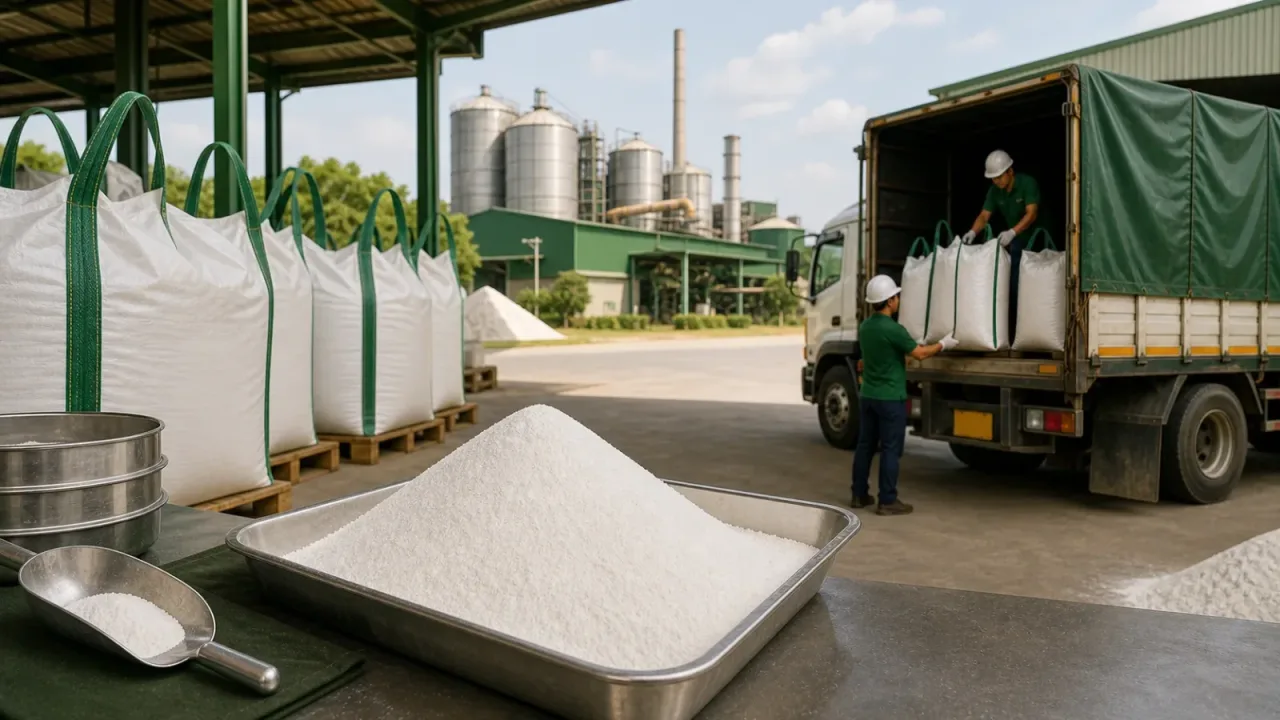
Summary of Raw Material Procurement Strategy: Decision-making is not solely based on "Unit Price"
The decision to purchase dried cassava pulp between the Ex-Warehouse (self-pickup) model and the Delivered (supplier-delivered) model must be viewed through the lens of "Total Cost of Ownership" (TCO). This article highlights that although the warehouse price may appear lower numerically, when factoring in hidden logistics costs, the risk of shrinkage, and the opportunity cost of management, the actual cost may exceed that of the delivered model. Conversely, while the delivered model carries a premium price, it enhances supply chain stability, reduces the burden of Inbound Quality Control (QC), and allows the factory to focus its resources effectively on maintaining production standards.
1. Raw Material Cost Management Strategy in the Animal Feed Industry
In the animal feed production industry, "dried cassava pulp" is a critical strategic raw material serving as a primary energy source. Managing the costs of this type of raw material is highly complex due to uncontrollable external factors.
The key challenges faced by feed mills are global market price volatility, domestic pricing mechanisms, and the uncertainty of transportation costs and fuel prices. Looking solely at the "Purchase Price" is insufficient for maintaining long-term competitiveness.
The objective of this in-depth article is to provide a comparative analysis between the Direct Cost shown on invoices and the Hidden Costs that are often overlooked, helping procurement officers and factory managers calculate the true breakeven point in raw material management.
2. Cost Analysis of Ex-Warehouse / Ex-Site Purchasing
Ex-warehouse purchasing involves the buyer taking full responsibility for managing transportation, which presents both advantages and disadvantages that require detailed consideration.
Visible Direct Costs
The most obvious advantage is the Base Price per unit, which is typically lower than the delivered price because the seller does not have to bear the burden of transportation costs and transit risks.
Logistics & Operational Costs
The buyer must bear the following costs arising from fleet management:
Risks and Hidden Costs of Loss (Shrinkage & Loss Risk)
This is the most critical aspect that often leads to budget overruns:
- Weight Loss: During long-distance transportation, dried cassava pulp may experience weight loss due to the evaporation of residual moisture or spillage during movement, which affects the actual amount of Dry Matter received.
- Moisture Control Risk: If logistics management is inadequate, such as using uncovered trucks, the raw material may absorb additional moisture from rain or humidity, resulting in changes to nutritional quality and increased risk of mold.
3. Cost Analysis of Delivered / Door-to-Door Purchasing
Delivered purchasing is an all-inclusive service, which transforms fixed costs into variable costs based on usage volume.
Perceived Direct Costs
The unit price per raw material acts as a Premium Price, as it already includes transportation services, risk management, and a delivery guarantee.
Operational Efficiency Advantages
Choosing this model helps reduce complexity in the workflow:
- Outsourcing Logistics: Reduces the need to establish a transportation unit or manage drivers.
- Weight Accuracy: Delivered suppliers often have clear Inbound Verification processes, reducing disputes regarding weight loss during transit.
- Supply Chain Continuity: A fixed delivery schedule helps mitigate the risk of production line interruptions due to raw material shortages.
Time Value Analysis (Opportunity Cost)
In economic terms, "personnel time" is highly valuable. When QC and production teams do not have to spend time tracking trucks or resolving logistics issues, they can focus these resources on maintaining Production Standards and increasing product yield, which generates more value for the company than the difference in raw material prices.
4. Technical and Economic Factors for Calculation (Technical Decision Matrix)
To achieve accurate decision-making, operators should use the following variables in their calculations:
Distance and Breakeven Variables
It is necessary to calculate the intersection between the "Price Spread" and the "Freight Rate per KM." If the distance from the production source to the factory is beyond the point where freight costs exceed the price spread, selecting the Ex-Warehouse model immediately becomes uncost-effective.
Capacity and Order Quantity Variables (Economy of Scale)
Order Quantity significantly impacts transportation costs:
- Bulk Transport vs. Small Load: Using large trucks (e.g., trailers) to transport large volumes at once reduces the cost per ton more effectively than frequent small loads.
- Ordering Frequency: Ordering too frequently increases handling costs, whereas ordering too much increases inventory carrying costs.
Quality and Standard Variables (Quality Consistency)
Stability of Moisture Content is a key variable. In the Ex-Warehouse model, moisture fluctuation during transit may be higher, but in the Delivered model, the supplier is typically responsible for controlling product quality according to specifications until it reaches the customer, which reduces the Rejection Rate at the factory gate.
5. Conclusion and Strategic Recommendations
No purchasing model is "the best" for every situation; there is only the model that is "most appropriate" for your factory's cost structure and capabilities.
Scenario A: When to Choose "Ex-Warehouse"
Suitable for factories with the following characteristics:
- Possess a highly efficient in-house logistics and fleet management system.
- Have a large warehouse capable of handling large bulk deliveries for stocking purposes.
- Have a very high usage volume that allows for bargaining power and managing unit costs lower than competitors.
Scenario B: When to Choose "Delivered"
Suitable for factories with the following characteristics:
- Need to reduce management complexity (Lean Management).
- Prioritize supply chain stability and product specification accuracy.
- Have fluctuating or inconsistent usage volumes, or limited warehouse space.
Checklist for Operators Before Deciding
| Evaluation Metric | High Consideration Required If... | Decision Target |
| Logistics Management | No in-house driving or fleet management team | Choose Delivered |
| Weight Risk | Concerned about weight loss (Shrinkage) during transit | Choose Delivered |
| Storage Space | Limited warehouse space; unable to accept Bulk | Choose Delivered |
| Cost Control Ability | Possess accurate IT and Fleet management systems | Choose Ex-Warehouse |
| Moisture Standards | Require constant moisture levels per COA from the source | Choose Delivered |
Note: If you require in-depth information regarding product specifications, Laboratory Analysis (COA), or would like to request a Quotation based on your preferred delivery terms, please contact our team of experts for professional technical and raw material management consultation.
Sources
- Thai Tapioca Starch Association - Tapioca Production - https://www.thaitapiocastarch.org/en/information/statistics/tapioca_production - ใช้ยืนยันภาพรวมผลผลิตมันสำปะหลังไทยและบริบท supply ของอุตสาหกรรม
- Thai Tapioca Starch Association - Export Tapioca Products - https://www.thaitapiocastarch.org/en/information/statistics/export_tapioca_products - ใช้ยืนยันสถิติส่งออกผลิตภัณฑ์มันสำปะหลัง รวมถึงหมวด Pulp
- Thai Tapioca Starch Association - Tapioca Starch Processing - https://thaitapiocastarch.org/en/information/learning_industry/tapioca_starch_processing - ใช้อธิบายกระบวนการผลิตแป้งมันและที่มาของผลพลอยได้จากโรงงานแป้งมัน
- ACFS / TAS 8803-2561 - มาตรฐานสินค้าเกษตร กากมันสำปะหลัง - https://www.opsmoac.go.th/udonthani-dwl-files-471491791858 - ใช้อ้างอิงนิยามกากมันสำปะหลังแห้ง/ผง/อัดเม็ด และข้อกำหนดพื้นฐาน เช่น ไม่พบเชื้อราหรือสิ่งแปลกปลอมที่มองเห็นได้
- GP Autoparts - Truck Law 2024 - https://www.gpautoparts.co.th/en/truck-law-2024-latest-regulations-and-penalties-that-truck-owners-need-to-know/ - ใช้ประกอบข้อจำกัดน้ำหนักรถบรรทุก เช่น 10 ล้อ 25 ตัน เพื่ออธิบาย full truck load
- Google Maps - https://www.google.com/maps - ใช้เป็นแหล่งตรวจระยะทางจริงก่อนเผยแพร่บทความจังหวัด เพราะระยะทางเปลี่ยนตามจุดเริ่มต้นและเส้นทาง
- Department of Land Transport - https://www.dlt.go.th/ - ใช้เป็นแหล่งอ้างอิงหน่วยงานกำกับดูแลการขนส่งทางบกเมื่อต้องตรวจข้อกำหนดล่าสุด

Author information
Sri Thong Admin
B2B dried cassava pulp content specialist
Affiliation
SRITHONG PRODUCTTAPIOCA COMPANY LIMITED