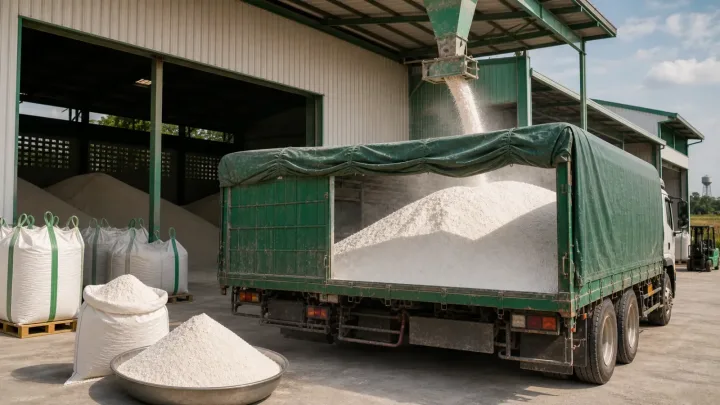
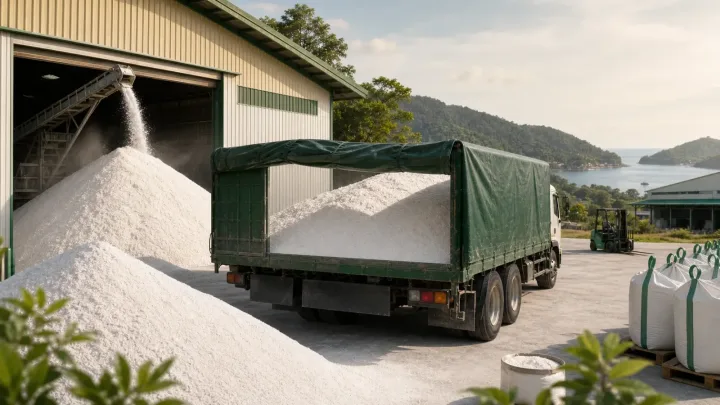
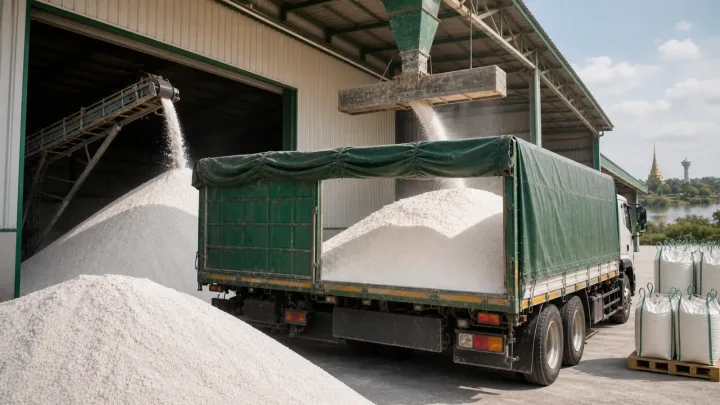
Shipping Dried Cassava Pulp from Korat to Rayong
By Sri Thong Admin · Published 2026-06-22 · Updated 2026-06-07
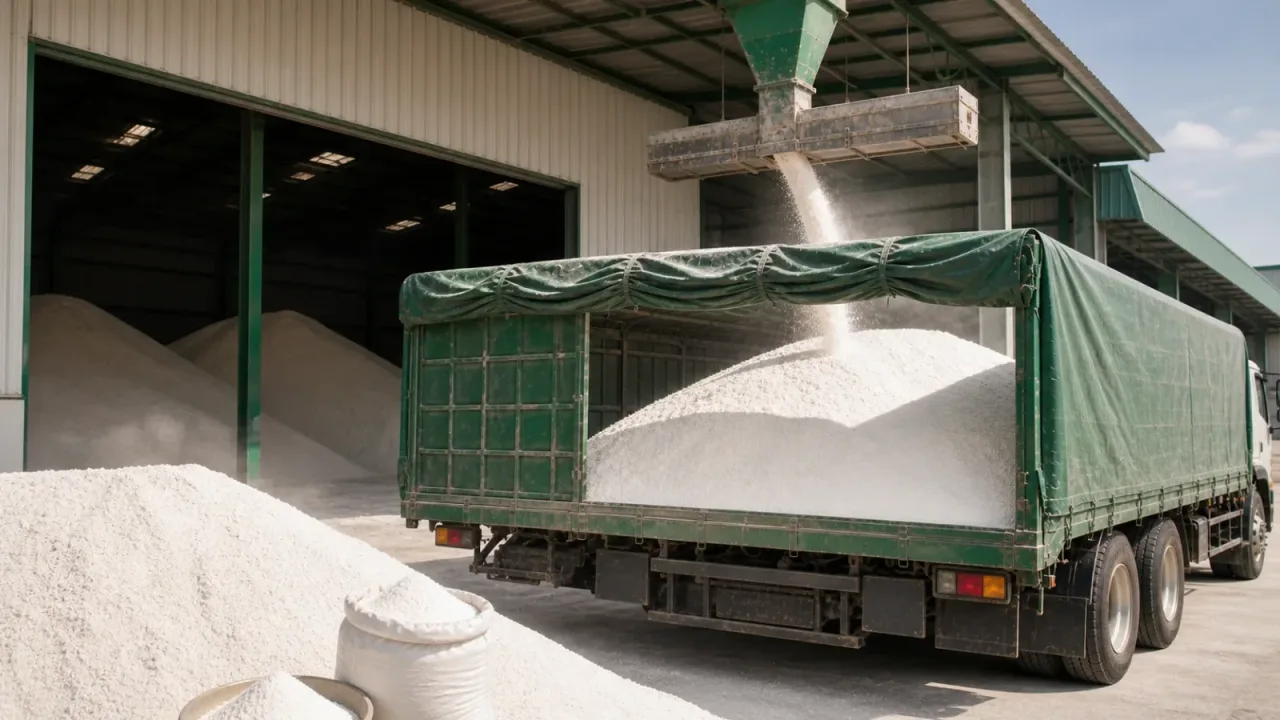
Executive Summary: Stabilizing the Cassava Pulp Supply Chain
The logistics management of dried cassava pulp from major production sources in Nakhon Ratchasima to animal feed factories in Rayong is not merely the transportation of raw materials from one point to another, but the management of "quality and nutritional value" throughout the journey. The core components include strict moisture control to prevent degradation, route planning to minimize weight shrinkage, and the use of real-time tracking technology to ensure that the raw materials delivered to the factory meet the standards specified in the COA (Certificate of Analysis), which is a fundamental factor in maintaining production costs and long-term animal feed quality.
1. Strategic Importance of the Cassava Pulp Supply Chain
In the animal feed industry, dried cassava residue/pulp serves as a vital energy source, particularly in ruminant feed formulas, due to its appropriate energy-providing properties and its ability to be a more cost-effective raw material than other energy sources during certain periods.
The economic structure of this raw material relies on the connection between two primary regions:
- Nakhon Ratchasima (Supply Hub): A strategic area with the highest density of cassava starch factory output, creating economies of scale in raw material collection.
- Rayong (Demand Hub): An area with a high density of international-standard animal feed factories, which require continuity in raw material delivery.
The challenges faced by operators are "distance" and "time." Long-distance cross-regional transportation poses risks to the physical and chemical properties of the raw materials. Without efficient logistics management, the materials arriving at the destination may fall below the agreed-upon standards.
2. Technical Specifications and Raw Material Standard Control
For animal feed factories, the acceptance of raw materials depends on the accuracy of the information in the COA. Therefore, quality control during the pre-loading stage is indispensable.
Key Parameters to Control
| Parameter | Impact on Production | Risk Factor |
| Moisture Content | Affects storage and shelf-life | Fermentation and mould |
| Residual Starch | Indicator of the energy level provided to animals | Loss of nutritional value |
| pH Level | Affects the chemical balance in the feed formula | Changes in chemical quality during transport |
Controlling moisture levels below the standard threshold (typically not exceeding 12-14%, depending on the agreement) is the key to inhibiting microbial growth during long-distance transport. If moisture levels are too high, heat accumulation in the truck bed will accelerate fermentation, causing changes in the odor and color of the raw material, which is unacceptable by industry standards.
3. Logistics Planning and Cost Management (Logistics Optimization)
Managing freight costs directly impacts the cost per ton of raw materials. Effective planning must consider both volume and routing dimensions.
Selection of Transport Modes and Loading Efficiency
Choosing the type of truck must balance freight costs and payload efficiency:
- Trailer: Suitable for large-scale transportation in a single trip, helping to reduce the number of trips and lowering the cost per unit, but requires careful management of weight to comply with legal regulations.
- 10-wheel truck: Offers high flexibility for accessing smaller production sources but may have a higher unit cost when compared by the same weight volume.
Shrinkage Management
A common problem in transporting agricultural raw materials is "weight discrepancy," which stems from two main factors: moisture evaporation due to heat and loss due to spillage. Implementing a double-check weighing system at both the origin and destination, along with analyzing standard shrinkage rates, will ensure that cost management is accurate and transparent.
Furthermore, route optimization via major routes such as Korat-Saraburi-Chonburi-Rayong must involve analyzing rest stops and avoiding heavy traffic periods to reduce lead time and unnecessary fuel consumption.
4. Quality Assurance and Risk Prevention Measures
One of the most critical risks in the animal feed industry is "contamination," which can lead to batch rejection and damage to the production line.
Cross-contamination Prevention Measures
Truck beds must undergo a cleanliness inspection every time before loading. It must be ensured that there are no chemical residues or traces of other raw materials that could affect the chemical properties of the cassava pulp.
Management of Cargo Container Environment
Transporting in areas with high relative humidity or during the rainy season requires external moisture protection (Rain Protection), such as using high-standard, leak-proof tarpaulins, and maintaining ventilation within the truck bed to reduce heat accumulation, which is the root cause of internal moisture and mycotoxin formation.
5. Data Management and Tracking Technology (Digital Traceability)
In the modern era, data transparency is a tool for building trust with B2B customers. Implementing technology is not an option but a necessity for quality control.
- GPS Tracking: Enables destination factories to accurately predict the Estimated Time of Arrival (ETA) and monitor driving behavior that could lead to impacts or damage to the raw materials.
- Digital Documentation: Moving from paper documents to e-Delivery Notes and recording moisture/weight values in a digital system improves accuracy and reduces human error.
- Real-time Quality Monitoring: Linking data from origin to destination creates supply chain transparency, which allows for rapid traceability if quality issues arise.
6. Conclusion and Future Outlook
Success in sourcing dried cassava pulp for animal feed factories depends on the integration of "raw material quality" and "logistics efficiency." Building a sustainable supply chain is becoming the new standard, particularly with the emphasis on Green Logistics to reduce the carbon footprint from transportation, which will become a key criterion in supplier evaluation in the future.
Key Success Factors include:
- Maintaining consistent moisture levels and chemical properties according to the COA.
- Efficiently controlling the rate of weight loss during transportation.
- Utilizing digital technology for transparency and traceability.
If you are looking for a business partner who understands the intricacies of animal feed raw material transportation and require further technical information, including product samples or Certificates of Analysis (COA), please contact our team of experts immediately to request pricing details and product specifications tailored to your factory's requirements.
Sources
- Thai Tapioca Starch Association - Tapioca Production - https://www.thaitapiocastarch.org/en/information/statistics/tapioca_production - ใช้ยืนยันภาพรวมผลผลิตมันสำปะหลังไทยและบริบท supply ของอุตสาหกรรม
- Thai Tapioca Starch Association - Export Tapioca Products - https://www.thaitapiocastarch.org/en/information/statistics/export_tapioca_products - ใช้ยืนยันสถิติส่งออกผลิตภัณฑ์มันสำปะหลัง รวมถึงหมวด Pulp
- Thai Tapioca Starch Association - Tapioca Starch Processing - https://thaitapiocastarch.org/en/information/learning_industry/tapioca_starch_processing - ใช้อธิบายกระบวนการผลิตแป้งมันและที่มาของผลพลอยได้จากโรงงานแป้งมัน
- ACFS / TAS 8803-2561 - มาตรฐานสินค้าเกษตร กากมันสำปะหลัง - https://www.opsmoac.go.th/udonthani-dwl-files-471491791858 - ใช้อ้างอิงนิยามกากมันสำปะหลังแห้ง/ผง/อัดเม็ด และข้อกำหนดพื้นฐาน เช่น ไม่พบเชื้อราหรือสิ่งแปลกปลอมที่มองเห็นได้
- GP Autoparts - Truck Law 2024 - https://www.gpautoparts.co.th/en/truck-law-2024-latest-regulations-and-penalties-that-truck-owners-need-to-know/ - ใช้ประกอบข้อจำกัดน้ำหนักรถบรรทุก เช่น 10 ล้อ 25 ตัน เพื่ออธิบาย full truck load
- Google Maps - https://www.google.com/maps - ใช้เป็นแหล่งตรวจระยะทางจริงก่อนเผยแพร่บทความจังหวัด เพราะระยะทางเปลี่ยนตามจุดเริ่มต้นและเส้นทาง
- Department of Land Transport - https://www.dlt.go.th/ - ใช้เป็นแหล่งอ้างอิงหน่วยงานกำกับดูแลการขนส่งทางบกเมื่อต้องตรวจข้อกำหนดล่าสุด

Author information
Sri Thong Admin
B2B dried cassava pulp content specialist
Affiliation
SRITHONG PRODUCTTAPIOCA COMPANY LIMITED