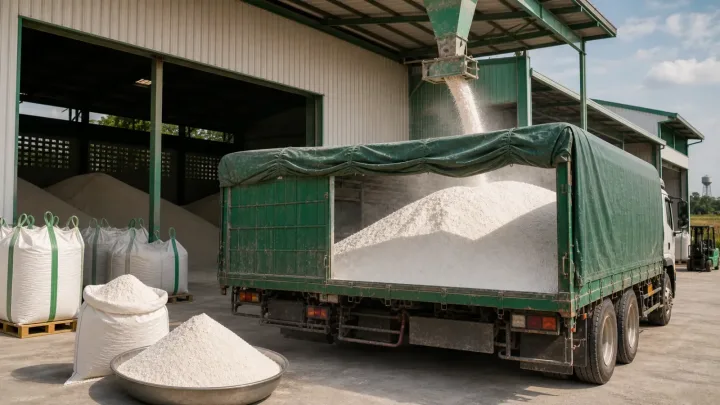
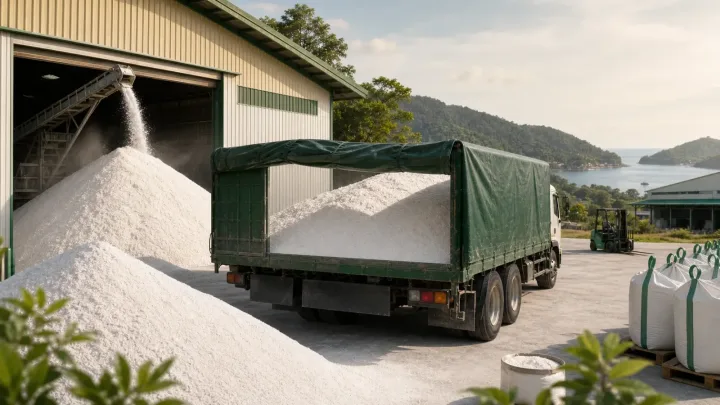
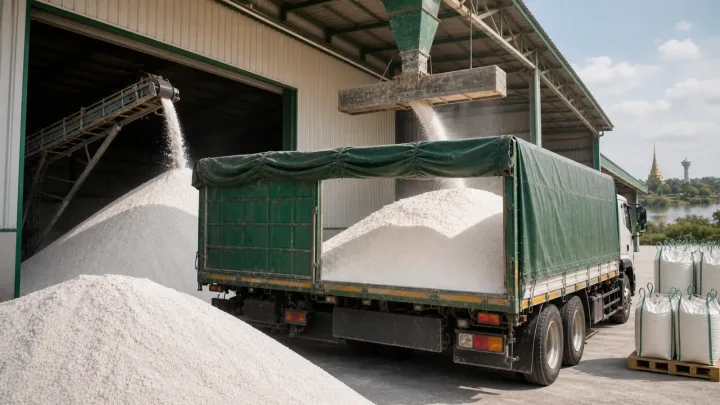
Shipping Dried Cassava Pulp from Korat to Nakhon Sawan
By Sri Thong Admin · Published 2026-06-21 · Updated 2026-06-07
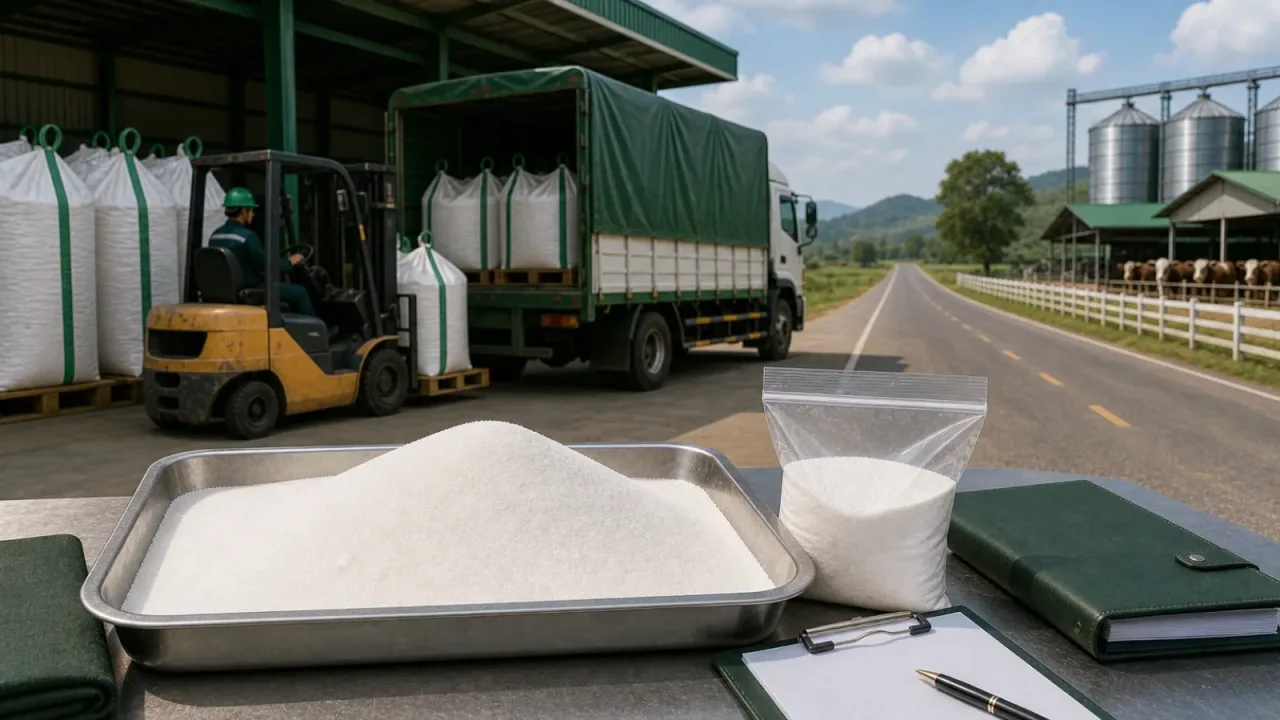
Executive Summary: Maintaining Quality Standards and Weight Stability in the Dried Tapioca Pulp Logistics Chain
The core of managing the Nakhon Ratchasima - Nakhon Sawan logistics route is not merely moving raw materials from production sites to feed mills, but controlling the "variance" in quality and weight. Dried tapioca pulp is highly sensitive to environmental conditions, particularly moisture and temperature, which directly impact nutrient levels and the total cost for buyers. Effective management must encompass everything from sampling at the source and preventing weight loss due to evaporation during transit to verifying weight accuracy and moisture levels at the destination. This ensures that the raw materials entering the animal feed production process are consistent with the predefined Technical Specifications and reduces the risk of mold growth or contamination that could compromise animal safety.
1. The Importance of the Dried Tapiable Pulp Transport Network in the Animal Feed Industry
In the animal feed production industry, dried tapioca pulp serves as a vital energy source due to its appropriate starch and carbohydrate content for livestock development. However, the challenge with this raw material lies in the "instability" of its physical properties if proper logistics management is lacking.
The route between Nakhon Ratchasima (the primary production hub) and Nakhon Sawan (the processing center and livestock farming hub) acts as the lifeblood of this industry. Land transportation faces two major risk factors:
- Changes in chemical quality: An increase in moisture that may lead to mold growth and mycotoxins (Aflatoxin).
- Economic loss: Weight loss due to moisture evaporation (Shrinkage) or physical loss of material during transport, which directly impacts the buyer's unit cost.
2. Technical Specifications & Quality Standards
Guaranteed raw material quality begins with establishing clear standard criteria so that both the Supplier and the Buyer operate under the same inspection benchmarks. The control of key parameters includes:
2.1 Moisture Content Control
Moisture is the most critical factor. If moisture levels exceed the standard threshold (typically not exceeding 12-14%, depending on the agreement), it increases the risk of microbial activity, which is the root cause of mold and Aflatoxin production—highly dangerous to the digestive systems of animals.
2.2 Dry Matter & Impurities Inspection
Monitoring Dry Matter allows feed mills to calculate feed formulations accurately. Furthermore, controlling impurities such as sand or dust is essential to prevent machinery abrasion during the production process and to maintain the cleanliness of the feed formula.
| Key Parameters | Recommended Standard | Risks if Substandard |
| Moisture | ≤ 1mu; 13-14% | Mold, spoilage, artificial weight gain |
| Impurities/Sand | As low as possible | Machinery wear, reduced nutrient value |
| Physical Characteristics | Dry, no sour odor | Product rejection, animal feed refusal |
3. Origin Management: Loading & Pre-shipment (Korat Side)
Transportation efficiency begins at the production plants in Nakhon Ratchasima. Effective management at the source helps reduce the burden of inspection at the destination.
3.1 Sampling and Pre-loading Inspection
A representative sampling process must be implemented across multiple points in the stockpile to check moisture levels and impurities before loading onto trucks. This data must be recorded in a Certificate of Analysis (COA) to be used for comparison upon arrival at the destination.
3ical 3.2 Moisture Control to Prevent Self-heating
One of the technical risks is loading cargo with excessively high moisture into trucks. When goods are piled in a closed space, heat accumulation (self-heating) can occur due to microbial respiration, which rapidly accelerates the degradation of the raw material during transit.
3.3 Payload Management
Controlling weight in accordance with legal regulations and customer requirements is vital. Overloading is not only illegal but also affects safety and fuel consumption rates, which increases hidden costs within the supply chain.
4. In-transit Logistics: Transportation Strategy and Environmental Control
During the route from Korat to Nakhon Sawan, the goods are exposed to constantly changing environmental conditions.
4.1 Vehicle Selection
The use of trailers or heavy trucks with complete tarpaulin covers (Tarped Trailers) is essential to prevent direct contact with rain and to reduce moisture re-absorption from the air during heavy rain or high humidity periods.
4.2 Shrinkage Management
Moisture in the pulp may evaporate during transit in hot weather, resulting in weight loss. Good logistics management must include an assessment of an "Allowable Tolerance" to ensure fairness for both the buyer and the seller.
5. Destination Process: Receiving & QA (Nakhon Sawan Side)
The destination process is the final decision stage regarding whether a specific lot meets the required standards.
5.1 Weighbridge Verification
Using a standardized weighbridge to verify the weight discrepancy between the origin and the destination is the most crucial step in preventing business disputes.
5.2 Re-testing and Non-conformance Management
Upon arrival, the QA team must perform re-testing, focusing on moisture levels and impurities. If the goods are found to be non-conforming (e.g., presence of mold or moisture exceeding the threshold), there must be a clear complaint management process, such as product cleaning, proportional price adjustments, or product rejection as per the contract agreement.
6. Executive Conclusion
In managing animal feed costs, looking solely at the "price per ton" can lead to economic errors. Executives should prioritize analyzing the Total Logistics Cost, which includes costs from weight loss, quality loss, and the risk of failing to meet production standards.
Recommendations for efficiency improvement:
- Technology Integration: Implementing GPS Tracking to monitor transit duration and using moisture sensors within the cargo to reduce product variance.
- Supply Chain Collaboration: Building transparent relationships between production sources in Korat and factories in Nakhon Sawan through data sharing will reduce risks and create long-term sustainability for the animal feed industry.
If you require further technical information regarding product specifications or wish to request product samples along with a Certificate of Analysis (COA) for feed formulation consideration, please contact our customer service department for detailed insights immediately.
Sources
- Thai Tapioca Starch Association - Tapioca Production - https://www.thaitapiocastarch.org/en/information/statistics/tapioca_production - ใช้ยืนยันภาพรวมผลผลิตมันสำปะหลังไทยและบริบท supply ของอุตสาหกรรม
- Thai Tapioca Starch Association - Export Tapioca Products - https://www.thaitapiocastarch.org/en/information/statistics/export_tapioca_products - ใช้ยืนยันสถิติส่งออกผลิตภัณฑ์มันสำปะหลัง รวมถึงหมวด Pulp
- Thai Tapioca Starch Association - Tapioca Starch Processing - https://thaitapiocastarch.org/en/information/learning_industry/tapioca_starch_processing - ใช้อธิบายกระบวนการผลิตแป้งมันและที่มาของผลพลอยได้จากโรงงานแป้งมัน
- ACFS / TAS 8803-2561 - มาตรฐานสินค้าเกษตร กากมันสำปะหลัง - https://www.opsmoac.go.th/udonthani-dwl-files-471491791858 - ใช้อ้างอิงนิยามกากมันสำปะหลังแห้ง/ผง/อัดเม็ด และข้อกำหนดพื้นฐาน เช่น ไม่พบเชื้อราหรือสิ่งแปลกปลอมที่มองเห็นได้
- GP Autoparts - Truck Law 2024 - https://www.gpautoparts.co.th/en/truck-law-2024-latest-regulations-and-penalties-that-truck-owners-need-to-know/ - ใช้ประกอบข้อจำกัดน้ำหนักรถบรรทุก เช่น 10 ล้อ 25 ตัน เพื่ออธิบาย full truck load
- Google Maps - https://www.google.com/maps - ใช้เป็นแหล่งตรวจระยะทางจริงก่อนเผยแพร่บทความจังหวัด เพราะระยะทางเปลี่ยนตามจุดเริ่มต้นและเส้นทาง
- Department of Land Transport - https://www.dlt.go.th/ - ใช้เป็นแหล่งอ้างอิงหน่วยงานกำกับดูแลการขนส่งทางบกเมื่อต้องตรวจข้อกำหนดล่าสุด

Author information
Sri Thong Admin
B2B dried cassava pulp content specialist
Affiliation
SRITHONG PRODUCTTAPIOCA COMPANY LIMITED