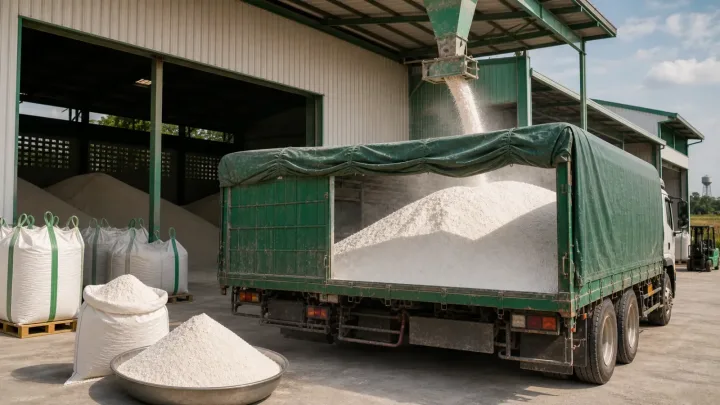
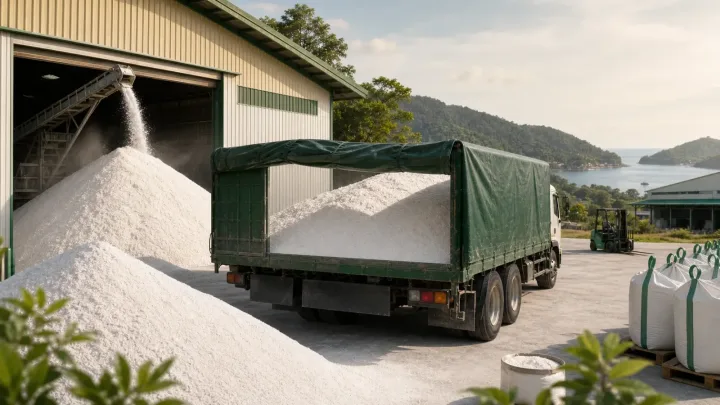
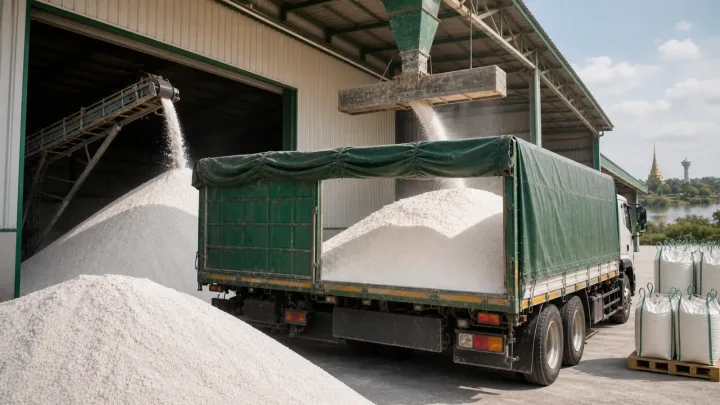
Shipping Dried Cassava Pulp from Korat to Phetchabun
By Sri Thong Admin · Published 2026-06-23 · Updated 2026-06-07
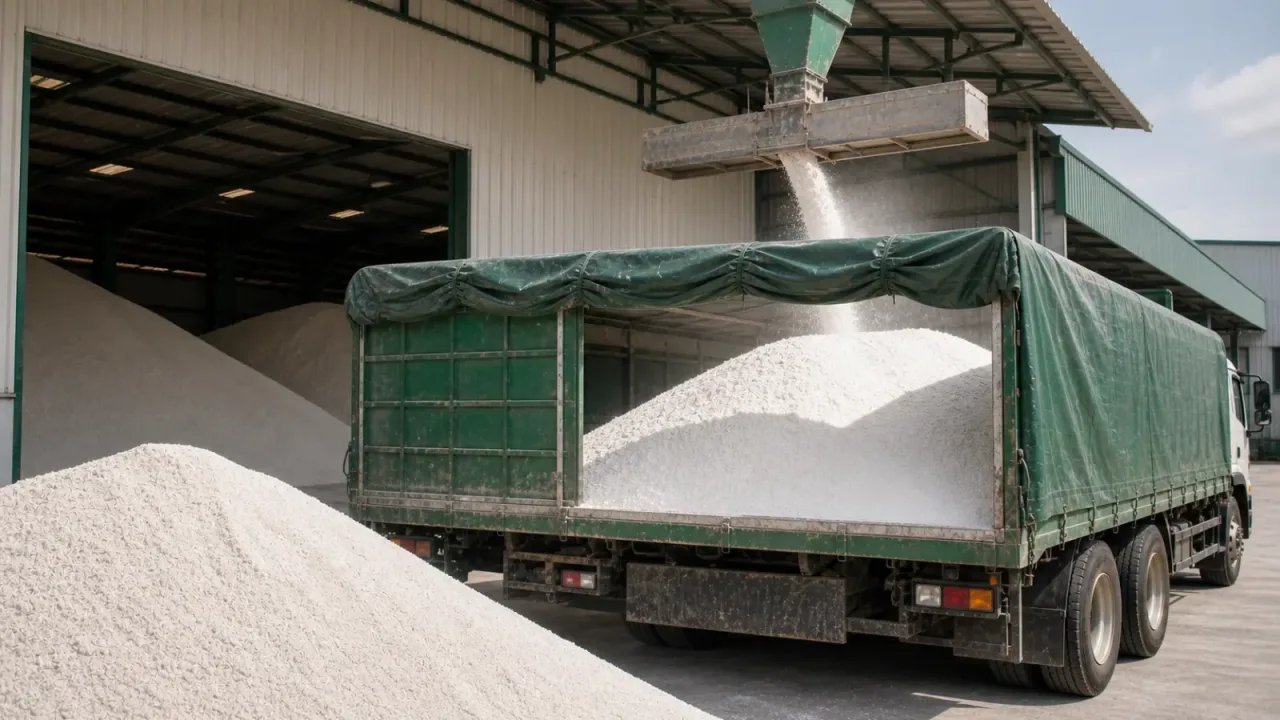
The essence of dried cassava pulp supply chain management on the Nakhon Ratchasima - Phetchabun route is not merely moving raw materials from origin to destination, but maintaining the stability of nutritional standards and biosafety throughout the journey. Success in sustainable animal feed cost reduction depends on strict moisture control, managing fungal risks during transport, and planning for seasonal supply fluctuations, ensuring that feed mills can be confident that the received raw materials meet technical COA specifications and are ready for the production process without contaminants.
1. Introduction: The Importance of Cassava Pulp in the Feed Industry
In the Feed Mill Industry, dried cassava pulp serves as a vital alternative raw material as a carbohydrate source, particularly for ruminants (such as beef cattle) and monogastrics requiring appropriate energy from starch and carbohydrates. Utilizing high-quality cassava pulp allows producers to effectively manage Least Cost Formulation.
The route between Nakhon Ratchasima (a primary production hub from cassava starch factories) and Phetchabun (a hub for livestock farms and feed mills) is a strategic logistics route in the agro-industry. Moving materials across this region involves economic complexities due to factors such as distance, transportation costs, and the risk of raw material degradation. Inefficient supply chain management directly impacts the Total Cost of Ownership and the quality of the final products in livestock farms.
2. Technical Quality Standards
Controlling the quality of dried cassava pulp requires laboratory-level testing to ensure that nutritional values meet product specifications. Key factors for feed mills include:
- Moisture Content: The most critical variable; if moisture levels exceed the standard threshold, it leads to mold growth and the spoilage process during transport.
- Starch Content and Fiber: Controlling the stability of starch and fiber ratios enables nutritionists to calculate feed formulas accurately.
- Contamination Control: Monitoring for foreign matter (such as soil, sand, or plastic) and controlling mycotoxins, such as Aflatoxin, which are hazardous to animals.
Furthermore, the moisture reduction process at the origin (Korat side) affects the physical structure of the material, which can be categorized into two main methods:
| Drying Method | Details and Impact on Quality |
| Sun Drying | Low cost, but involves high uncertainty due to weather; moisture may be uneven, and there is a risk of contamination from dust and the environment. |
| Mechanical Drying | Allows for precise control of temperature and moisture levels, providing high product consistency and reducing the risk of mold. |
3. Logistics & Transportation Management
Transporting cassava pulp from Korat to Phetchabun is not just about moving goods; it is about managing "risks" along the way to maintain product quality identical to when it left the factory.
Route Optimization: Truck fleet management must involve route planning to reduce distance and transport time, which efficiently controls fuel costs and minimizes the risk of raw materials being exposed to hot and humid environments for extended periods.
Micro-climate Control: The most critical issue is heat accumulation and moisture within the truck beds, which accelerates mold growth. Therefore, inspecting vehicle cleanliness and preventing cross-contamination from previous cargoes is an indispensable measure.
Payload Optimization: Calculating the load to comply with legal weight limits and vehicle capacity ensures maximum efficiency per trip (Cost per Ton) while maintaining driving safety and product integrity.
4. Supply Chain & Market Dynamics
Supply chain management must face uncontrollable external fluctuations:
- Demand & Supply Imbalance: Demand for cassava pulp in Phetchableun often depends on livestock production cycles, while supply from starch factories in Korat depends on sugarcane and cassava harvest seasons. Safety stock management must be paired with production forecasting.
- Seasonality: During the rainy season, the amount of cassava pulp that can be processed into a dry form decreases due to the difficulty of moisture reduction, impacting both market price and product volume.
- Price and Freight Volatility: Global energy and crude oil prices directly impact logistics costs. Utilizing forward contracts or long-term transportation service agreements is a strategy to mitigate cost risks.
5. Post-Arrival Handling & Storage
Upon arrival at the feed mill, the critical immediate step is Incoming Quality Control (IQC). Sampling for moisture and physical characteristics must be systematic. If products do not meet the COA, a clear Non-conformance Report (NCR) process must be followed.
Regarding Warehouse Management, storing dried cassava pulp requires focus on:
- Ventilation: To prevent heat accumulation within the product pile, which causes degradation.
- Humidity Control: Managing relative humidity in the storage area to prevent the re-emergence of mold.
- FIFO (First-In, First-Out): Inventory management using the FIFO principle to prevent raw materials from being stored too long and losing nutritional value.
6. Conclusion & Future Outlook
The success of dried cassava pulp supply chain management on the Korat - Phetchabun route does not rely on a single factor but results from the integration of technical standards, efficient logistics management, and systematic warehousing. The core objective is to build confidence for feed producers that every ton delivered will be consistent in quality and safe.
In the future, we are entering the era of Digital Traceability, where IoT and Blockchain technologies will play a role in the real-time Track & Trace of raw material quality—from moisture levels in trucks to production history from starch factories. This will reduce risks and create opportunities to enhance macro-level animal feed production capabilities, elevating the competitiveness of the Thai livestock industry on the global stage.
Sources
- Thai Tapioca Starch Association - Tapioca Production - https://www.thaitapiocastarch.org/en/information/statistics/tapioca_production - ใช้ยืนยันภาพรวมผลผลิตมันสำปะหลังไทยและบริบท supply ของอุตสาหกรรม
- Thai Tapioca Starch Association - Export Tapioca Products - https://www.thaitapiocastarch.org/en/information/statistics/export_tapioca_products - ใช้ยืนยันสถิติส่งออกผลิตภัณฑ์มันสำปะหลัง รวมถึงหมวด Pulp
- Thai Tapioca Starch Association - Tapioca Starch Processing - https://thaitapiocastarch.org/en/information/learning_industry/tapioca_starch_processing - ใช้อธิบายกระบวนการผลิตแป้งมันและที่มาของผลพลอยได้จากโรงงานแป้งมัน
- ACFS / TAS 8803-2561 - มาตรฐานสินค้าเกษตร กากมันสำปะหลัง - https://www.opsmoac.go.th/udonthani-dwl-files-471491791858 - ใช้อ้างอิงนิยามกากมันสำปะหลังแห้ง/ผง/อัดเม็ด และข้อกำหนดพื้นฐาน เช่น ไม่พบเชื้อราหรือสิ่งแปลกปลอมที่มองเห็นได้
- GP Autoparts - Truck Law 2024 - https://www.gpautoparts.co.th/en/truck-law-2024-latest-regulations-and-penalties-that-truck-owners-need-to-know/ - ใช้ประกอบข้อจำกัดน้ำหนักรถบรรทุก เช่น 10 ล้อ 25 ตัน เพื่ออธิบาย full truck load
- Google Maps - https://www.google.com/maps - ใช้เป็นแหล่งตรวจระยะทางจริงก่อนเผยแพร่บทความจังหวัด เพราะระยะทางเปลี่ยนตามจุดเริ่มต้นและเส้นทาง
- Department of Land Transport - https://www.dlt.go.th/ - ใช้เป็นแหล่งอ้างอิงหน่วยงานกำกับดูแลการขนส่งทางบกเมื่อต้องตรวจข้อกำหนดล่าสุด

Author information
Sri Thong Admin
B2B dried cassava pulp content specialist
Affiliation
SRITHONG PRODUCTTAPIOCA COMPANY LIMITED