Dry Cassava Pulp for Export Traders: What Specifications Should You Check?
By Sri Thong Admin · Published 2026-06-10 · Updated 2026-06-07
Executive Summary: The Essence of Quality Control for Cassava Chips for Export
Operating an international trading and production business for animal feed ingredients is not merely about sourcing sufficient quantities to fulfill orders, but about effective "Risk Management." The core of high-quality Cassava Chips is measured not only by volume but by the precision of Physical, Chemical, and Safety parameters. If these values deviate from the agreed-upon Specifications, the resulting consequences include Rejection Costs, massive expenses from product rejection, weight loss due to moisture evaporation, and the risk of product degradation during maritime transport. Therefore, deep understanding of technical specifications and meticulous inspection of COA documents are vital mechanisms that enable both buyers and sellers to build trust within the global supply chain.
1. Quality Significance in Global Trade
In the global animal feed market, cassava chips are a vital Energy Source. Moving products from production sites to international feed mills involves long Transit Times; therefore, quality is the true determinant of cost.
The Trader's Challenge: Rejection Cost
For traders, even a minor error in moisture levels or the presence of excessive impurities can lead to product Rejection at the port or upon arrival at the destination factory. This includes costs for product destruction, Demurrage, and long-term loss of credibility with partners. Controlling quality at the source is the only way to mitigate these hidden costs.
Defining Standard Grade vs. Premium Grade
From the perspective of international buyers, "Standard Grade" may refer to products meeting minimum legal requirements, whereas "Premium Grade" refers to products with high Uniformity, extremely low impurities, and stable starch levels—which is precisely what global feed mills require for precise Feed Formulation.
2. Physical Specifications: The First Line of Inspection
Physical characteristics are the first things QC officers inspect upon the product's arrival. If the product fails these criteria, it will be rejected immediately without waiting for chemical test results.
Moisture Content and the Risk of Mold
Moisture is the most critical variable. Standard criteria typically do not exceed 13-14%. If moisture levels exceed the limit, it triggers biological processes within bags or containers, leading to Molding, which results in unpleasant Odors and mycotoxin contamination in the product.
Controlling Impurities/Foreign Matter
The presence of high levels of Sand, Soil, or Stone not only reduces the effective product weight (as these are non-nutritional extras) but also causes Abrasion to the customer's downstream animal feed production machinery.
Size Distribution
Consistency in Flake size affects subsequent processing, such as grinding or conversion into cassava starch. Inconsistent sizing leads to instability in the production process.
Cleanliness
Detecting excessive Peel content or Fiber will affect the total energy value of the feed formula, as peel contains a lower proportion of starch compared to the cassava pulp.
3. Chemical & Nutritional Specifications: The Core of Product Value
Chemical values determine the "Price" and "Efficiency" of the product when used as a raw material.
Starch Content: The Primary Value Driver
Starch content is the most important Value Driver. The higher the starch content, the higher the value of the cassava chips, correlating directly with market prices.
Reducing Sugars and Stability
Excessively High Reducing Sugars pose a risk of Fermentation during maritime transport, which can cause discoloration, a sour odor, and Clumping.
pH Value
An appropriate pH value indicates product stability. A drastic change in pH may signal the onset of microbiological degradation.
Protein & Fiber Content
Although cassava chips are low in protein, accurate Fiber and Protein data is essential for Animal Nutritionists to calculate the nutrient balance in feed formulas.
4. Safety & Contaminant Standards
In markets with strict regulations, such as China or Europe, safety is a non-negotiable condition.
Cyanide/HCN Content
Cassava contains naturally occurring cyanide compounds. Controlling Hydrocyanic acid (HCN) levels to stay within safety limits for livestock is a mandatory standard that producers must strictly manage.
Microbiological Contaminants
The detection of mold (such as Aflatoxin) or pathogenic bacteria (such as Salmonella) is an international legal requirement; even trace amounts can lead to the destruction of an entire batch.
Heavy Metals & Pesticides
Controlling levels of heavy metals (such as Lead and Cadmium) and pesticide residues is a critical part of Food Safety Compliance for exporting to premium markets.
5. Logistics & Packaging Integrity
Even high-quality products can be damaged if logistics management fails.
Packaging Standards
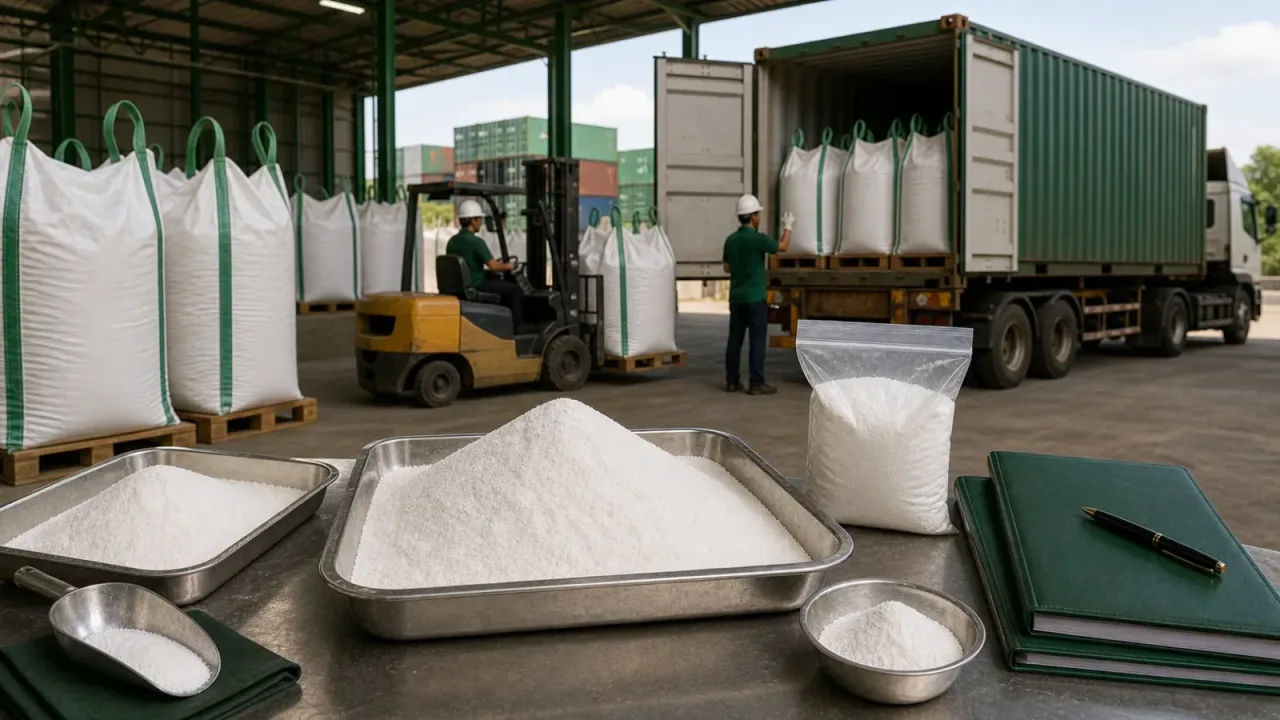
The use of durable Jumbo Bags and Bulk packaging requires rigorous planning for protection against external moisture.
Container Sweat Risk
Temperature fluctuations during sea transit can cause "Container Sweat," which is a primary cause of increased moisture within the product, leading to mold growth.
Importance of Certification & Documentation
A COA (Certificate of Analysis) that transparently specifies all parameters is vital evidence confirming that the product complies with the sales contract.
6. Conclusion and Trader’s Quality Control Checklist
To mitigate trading risks, traders should use the summary table below as a benchmark for inspecting goods and preparing for Factory Audits.
| Parameter | Standard Specification (Should be specified in contract) | Risk if Out of Spec |
| Moisture | Max 13.0% - 14.0% | Mold, Fermentation, Weight Loss |
| Impurities | Max 2.0% - 5.0% (depending on grade) | Machine Damage, Loss of Weight |
| Cyanide | Within Safety Limits (per destination country standards) | Animal Toxicity, Legal Rejection |
| Starch | As per Agreement | Loss of Value/Price adjustment |
| Aflatoxin | Non-detectable or Below Limit | Total Batch Rejection, Safety Risk |
Factory Audit Strategy:
The best way to reduce risk is through Proactive Auditing—visiting factories to inspect the entire process, from washing and chipping to drying and storage in Silos. If a factory utilizes modern moisture control and impurity separation systems, it will increase confidence that the product received will be consistently high-quality, exactly as specified in the COA.
Sources
- Thai Tapioca Starch Association - Tapioca Production - https://www.thaitapiocastarch.org/en/information/statistics/tapioca_production - ใช้ยืนยันภาพรวมผลผลิตมันสำปะหลังไทยและบริบท supply ของอุตสาหกรรม
- Thai Tapioca Starch Association - Export Tapioca Products - https://www.thaitapiocastarch.org/en/information/statistics/export_tapioca_products - ใช้ยืนยันสถิติส่งออกผลิตภัณฑ์มันสำปะหลัง รวมถึงหมวด Pulp
- Thai Tapioca Starch Association - Tapioca Starch Processing - https://thaitapiocastarch.org/en/information/learning_industry/tapioca_starch_processing - ใช้อธิบายกระบวนการผลิตแป้งมันและที่มาของผลพลอยได้จากโรงงานแป้งมัน
- ACFS / TAS 8803-2561 - มาตรฐานสินค้าเกษตร กากมันสำปะหลัง - https://www.opsmoac.go.th/udonthani-dwl-files-471491791858 - ใช้อ้างอิงนิยามกากมันสำปะหลังแห้ง/ผง/อัดเม็ด และข้อกำหนดพื้นฐาน เช่น ไม่พบเชื้อราหรือสิ่งแปลกปลอมที่มองเห็นได้
- FAO - Roots, tubers, plantains and bananas in animal feeding - https://www.fao.org/4/T0554E/T0554E05.htm - ใช้ยืนยันประเด็นความชื้น สิ่งปลอมปน เถ้า ทราย และความเสี่ยง aflatoxin ในสินค้า cassava/feed
- FAO - Thailand Feed and Feed Ingredient Standards - https://www.fao.org/fileadmin/user_upload/affris/docs/standard/Thailand_Feed_and_Feed_Ingredient_Standards.pdf - ใช้เป็นตัวอย่างโครงสร้างค่าวิเคราะห์วัตถุดิบอาหารสัตว์ เช่น moisture, protein, fiber, ash
- DLD - การตรวจอะฟลาทอกซินในวัตถุดิบอาหารสัตว์ - https://qcontrol.dld.go.th/images/Prototype/knowledge/analysis/2565/13.pdf - ใช้สนับสนุนหัวข้อ aflatoxin, วิธีวิเคราะห์ และเหตุผลที่ควรตรวจเป็นรอบเมื่อมีความเสี่ยง

Author information
Sri Thong Admin
B2B dried cassava pulp content specialist
Affiliation
SRITHONG PRODUCTTAPIOCA COMPANY LIMITED