How to Plan Monthly Orders of 250–400 Tons of Dried Cassava Pulp
By Sri Thong Admin · Published 2026-06-08 · Updated 2026-06-07
Successfully managing 250-400 tons of dried cassava pulp per month requires more than just securing the required volume; it necessitates the integration of a balance between "Quality Consistency," "Supply Continuity," and "Total Cost Optimization" through rigorous technical inspection systems, precise logistics planning, and seasonal fluctuation risk management to prevent long-term impacts on production costs and animal feed safety standards.
Challenges of Large-Scale Raw Material Management (Scale & Complexity)
In the animal feed manufacturing industry, dried cassava pulp serves as a vital energy source and plays a significant role in restructuring feed formulation costs. However, as demand scales to the 200–400 tons per month level, challenges extend beyond mere sourcing to include structural complexities across three main dimensions:
1. Logistics: Moving massive quantities of raw materials requires consistent truck turnaround cycles; poor management leads to bottlenecks at the factory gates.
2. Storage: A volume of 400 tons per month requires storage space with controlled environmental conditions to prevent degradation.
3. Quality Consistency: Maintaining a stable nutrient profile across every delivery lot is the core of controlling animal feed production standards.
Strategic Sourcing & Supply Chain Management
Managing raw materials at an industrial scale requires proactive sourcing strategies to mitigate the risk of over-reliance on a single source.
Supplier Segmentation and Risk Diversification
Factories should segment suppliers into multiple tiers, such as large starch factories to focus on volume, cassava depots for flexibility, and farmer networks for upstream quality control. Having multiple supplier groups enables the factory to maintain the 400 tons per month target even if an individual supplier faces production issues.
Seasonal Management and Contract Management
Since agricultural yields are subject to seasonal fluctuation, forward contracts are essential tools for locking in both volume and price (Price Stability) to prevent raw material cost spikes during low-production periods. Furthermore, Capacity Audits must be conducted to verify that suppliers possess the actual capability to support continuous delivery.
Technical Quality Control Protocol
As a feed manufacturer, even minor quality errors can impact the Feed Conversion Ratio (FCR) of livestock and lead to a loss of customer trust. Therefore, establishing specifications must be clear and verifiable.
Critical Parameters to Control
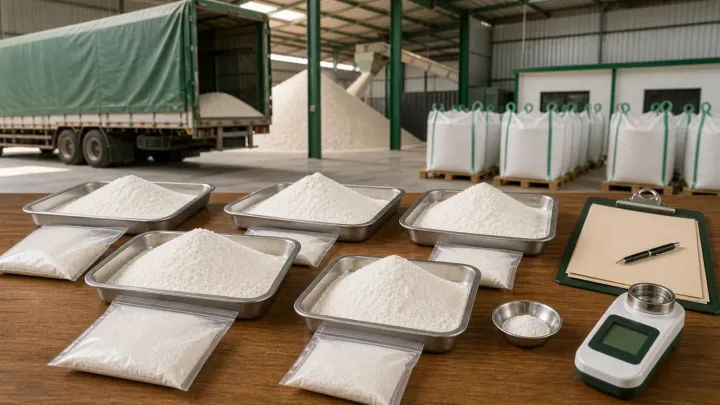
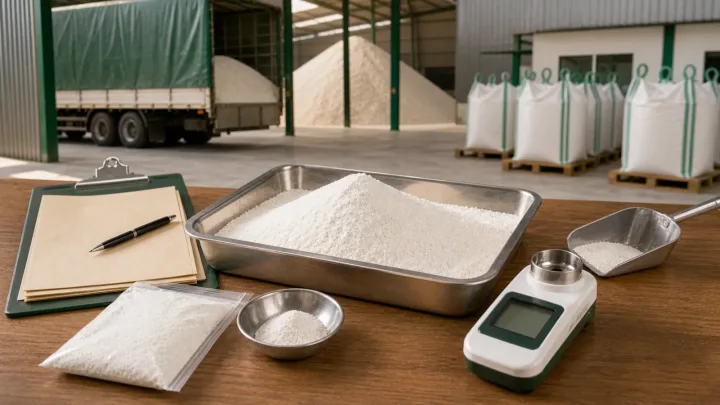
Goods receiving must cover the following physical and chemical indicators:
| Parameter | Importance to Production | Impact of Non-compliance |
| Moisture Content | Controls mold growth | Rapid spoilage, Aflatoxin formation |
| Starch Content | Primary energy source in formula | Nutritional energy levels do not meet specs |
| Impurities/Sand | Reduces machinery wear | Equipment damage, high machinery wear |
| Fiber | Controls dietary fiber levels in animals | Affects animal digestion systems |
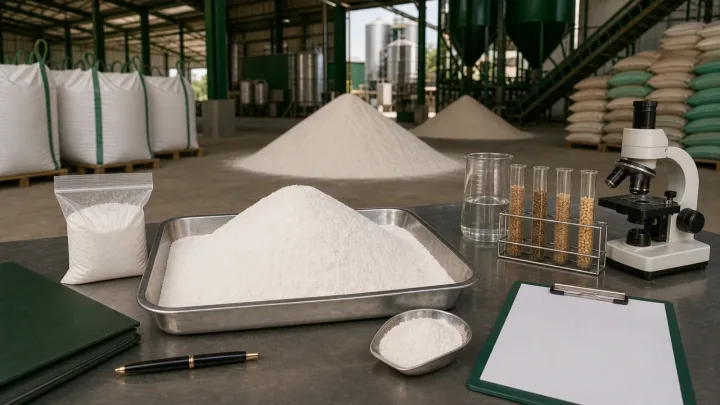
Additionally, importance must be placed on hazardous contaminants, such as residual cyanide, and a sampling protocol that adheres to international standards to ensure that analytical results truly reflect the quality of the entire lot. A clear Rejection Policy must also be established to define the conditions for rejecting goods, thereby minimizing losses within the production process.
Logistics & Inbound Operations Management
Managing inbound logistics for 400 tons/month must focus on Efficiency and Accuracy.
- Truck Scheduling & Flow Management: Implementing truck arrival/departure schedules (Slot Management) to prevent congestion at the factory gates, which impacts truck idling costs.
- Unloading Capacity: Calculating the discharge rate to align with machinery and labor capacity to prevent bottlenecks in the receiving process.
- Weight Verification: A weight verification system via weighbridges that undergoes regular calibration to prevent quantitative errors and prevent fraud.
Warehouse & Inventory Management
A warehouse is not merely a storage space; it is an integral part of the raw material quality preservation process.
Infrastructure and Inventory Control
The choice between using Silos or a Warehouse must be based on usage volume and product turnover. Strict implementation of the First-In, First-Out (FIFO) system is essential to prevent the accumulation of old raw materials that may have degraded.
Environmental Control and Traceability
Effective moisture management (Ventilation) and pest management systems are required. Most importantly, a traceability system must be implemented by recording Lot Numbers and arrival dates to ensure rapid investigation if quality issues are detected in the finished products.
Cost & Risk Analysis
B2B procurement decisions must look beyond "Price per Ton" and instead consider the Total Cost of Ownership (TCO).
Total Cost of Ownership (TCO) includes:
- Base raw material cost
- Logistics Cost
- Holding Cost
- Shrinkage/Degradation Cost
Furthermore, factories must have a Contingency Plan for scenarios involving raw material shortages caused by natural disasters or extreme market price volatility, as well as managing Cash Flow sufficiently to allow for bulk purchasing when market prices are optimal.
Conclusion: The Key to Success
The most efficient management of 250-400 tons of dried cassava pulp per month is the systematic integration of "Quality, Quantity, and Cost." Utilizing Data Logging technology to store inbound, quality, and cost data will enable management to engage in Data-Driven Decision Making for precise and sustainable production planning.
Sources
- Thai Tapioca Starch Association - Tapioca Production - https://www.thaitapiocastarch.org/en/information/statistics/tapioca_production - ใช้ยืนยันภาพรวมผลผลิตมันสำปะหลังไทยและบริบท supply ของอุตสาหกรรม
- Thai Tapioca Starch Association - Export Tapioca Products - https://www.thaitapiocastarch.org/en/information/statistics/export_tapioca_products - ใช้ยืนยันสถิติส่งออกผลิตภัณฑ์มันสำปะหลัง รวมถึงหมวด Pulp
- Thai Tapioca Starch Association - Tapioca Starch Processing - https://thaitapiocastarch.org/en/information/learning_industry/tapioca_starch_processing - ใช้อธิบายกระบวนการผลิตแป้งมันและที่มาของผลพลอยได้จากโรงงานแป้งมัน
- ACFS / TAS 8803-2561 - มาตรฐานสินค้าเกษตร กากมันสำปะหลัง - https://www.opsmoac.go.th/udonthani-dwl-files-471491791858 - ใช้อ้างอิงนิยามกากมันสำปะหลังแห้ง/ผง/อัดเม็ด และข้อกำหนดพื้นฐาน เช่น ไม่พบเชื้อราหรือสิ่งแปลกปลอมที่มองเห็นได้
- FAO - Roots, tubers, plantains and bananas in animal feeding - https://www.fao.org/4/T0554E/T0554E05.htm - ใช้ยืนยันประเด็นความชื้น สิ่งปลอมปน เถ้า ทราย และความเสี่ยง aflatoxin ในสินค้า cassava/feed
- FAO - Thailand Feed and Feed Ingredient Standards - https://www.fao.org/fileadmin/user_upload/affris/docs/standard/Thailand_Feed_and_Feed_Ingredient_Standards.pdf - ใช้เป็นตัวอย่างโครงสร้างค่าวิเคราะห์วัตถุดิบอาหารสัตว์ เช่น moisture, protein, fiber, ash
- DLD - การตรวจอะฟลาทอกซินในวัตถุดิบอาหารสัตว์ - https://qcontrol.dld.go.th/images/Prototype/knowledge/analysis/2565/13.pdf - ใช้สนับสนุนหัวข้อ aflatoxin, วิธีวิเคราะห์ และเหตุผลที่ควรตรวจเป็นรอบเมื่อมีความเสี่ยง

Author information
Sri Thong Admin
B2B dried cassava pulp content specialist
Affiliation
SRITHONG PRODUCTTAPIOCA COMPANY LIMITED