Dried Cassava Pulp Specs Purchasing & QC Should Check
By Sri Thong Admin · Published 2026-06-06 · Updated 2026-06-07
Executive Summary: Quality Control of Cassava Pulp for Production Efficiency and Cost Optimization
Managing Dried Cassava Pulp in the animal feed industry is not merely about finding a low-cost energy source, but about managing the risk between "raw material costs" and "nutritional standards." For Procurement, the key is controlling supply chain continuity and preventing weight loss due to moisture (Shrinkage). Meanwhile, Quality Control (QC) must focus on inspecting physical characteristics, contaminants (especially cyanide and mold), and the accuracy of nutritional values to ensure that feed formulations are stable, safe, and compliant with international standards such as GMP and HACCP. A detailed review of the Certificate of Analysis (COA) is, therefore, a vital tool for decision-making regarding product acceptance or price negotiation.
1. Introduction: The Strategic Role of Cassava Pulp in Feed Formulation
In the animal feed production industry, dried cassava pulp serves as a critical alternative raw material and a vital energy source due to its high starch proportion relative to its cost. However, utilizing large quantities of cassava pulp for cost optimization brings complex technical challenges that can be divided into two main areas:
Procurement Challenges: Risk management extends beyond price negotiation to include managing price volatility due to seasonality and maintaining supply chain continuity. Purchasing raw materials with excessive moisture or high impurities not only leads to weight loss (Shriment) during transport and storage but also significantly impacts the company's cash flow.
QC Challenges: The primary objective for QC is to control nutritional consistency and safety. Since cassava pulp is a by-product with high specification variability, if QC cannot maintain standards as defined by nutritionists, it will directly impact animal performance (growth) and the safety of the end consumers.
2. Physical Specifications: Preliminary Assessment at the Receiving Dock
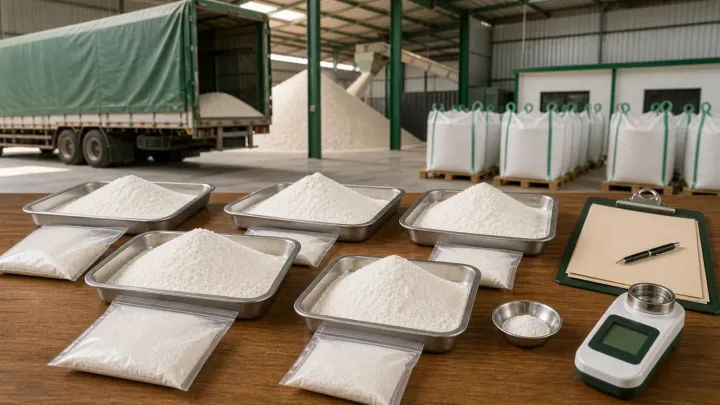
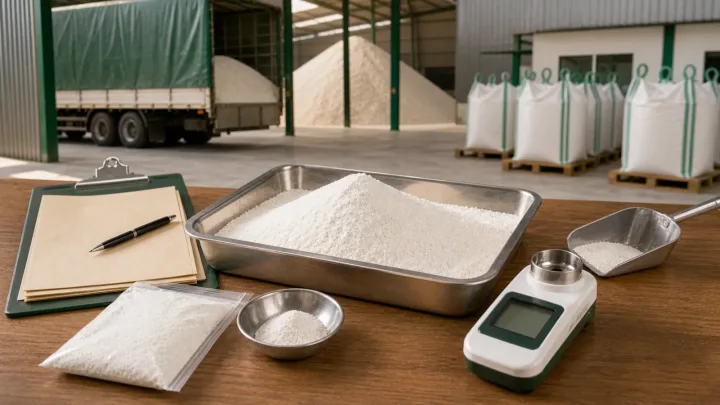
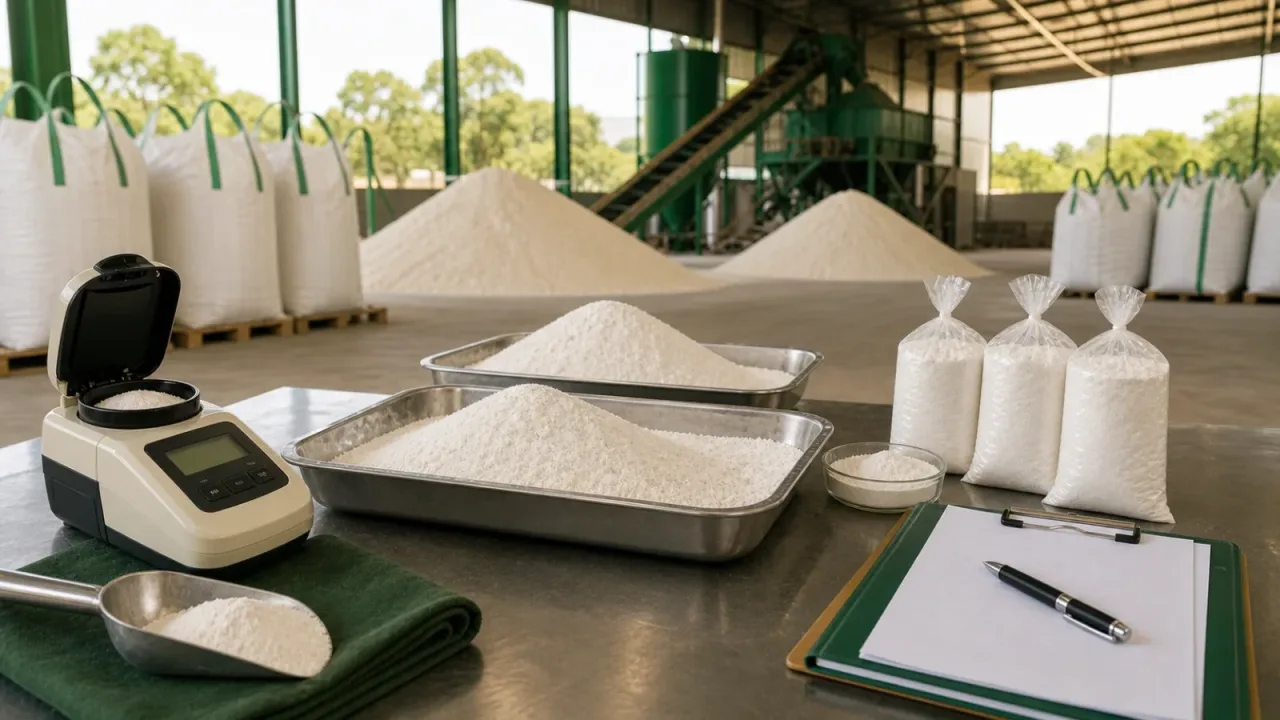
Physical inspection is the most important first line of defense, as it can be performed immediately at the receiving dock to serve as evidence for accepting or rejecting shipments.
- Moisture Content: This is the variable that most affects procurement economics. If moisture exceeds specifications, it leads to unforeseen weight loss (Shrinkage) not specified in the contract. Additionally, high moisture is a primary driver for mold growth and reduces the shelf-life of the raw material in the warehouse.
- Impurities & Foreign Matter: The presence of soil, sand, stones, plastic, metal, or wood not only reduces nutritional value but also poses a serious risk to production machinery (such as grinders or mixers), potentially causing expensive equipment damage. The source of these impurities often reflects the vendor's processing standards.
- Particle Size Distribution: Size uniformity directly affects mixing homogeneity. Inconsistent particle sizes can lead to segregation issues during production and packaging.
- Organoleptic Properties: Visual and olfactory observations—such as abnormal discoloration (indicating burning or chemical degradation) or sour/musty odors (indicating improper fermentation or microbial contamination)—serve as rapid indicators of raw material freshness.
3. Chemical & Nutritional Specifications: The Heart of Formulation Calculations
Chemical nutritional values are the data used by nutritionists for least-cost formulation. If these values deviate from the COA, actual production costs will be higher than calculated.
Starch Content
Starch is the primary indicator of energy density in cassava pulp. Accurate starch measurement allows factories to assess the true energy value of the raw material to correctly calculate the total energy in the feed formulation.
Crude Protein
Although cassava pulp is low in protein, monitoring protein deviations is essential to ensure that re-formulation—when switching raw material sources—does not result in total protein levels falling below required standards.
Fiber Content (NDF/ADF)
Fiber content (Neutral Detergent Fiber / Acid Detergent Fiber) affects digestibility, especially in ruminants. Excessive fiber levels can negatively impact feed intake and the Feed Conversion Ratio (FCR).
pH Value
Monitoring pH helps in detecting signs of undesirable microbial fermentation, which can lead to changes in the quality of the primary nutrients in the raw material.
4. Safety & Contaminant Specifications: Advanced Risk Management
In an era of increasingly stringent animal feed export standards, controlling contaminants is the core of food safety.
- Cyanide Content: Since cassava pulp is derived from the cassava root, controlling cyanide levels below animal safety thresholds is "indispensable." Excessive levels can lead to irreversible impacts on animal health and mortality rates.
- Mycotoxins: Monitoring for Aflatoxin or other toxins that may contaminate the product due to high moisture during storage is a critical QC duty to prevent damage to animal health and chemical residues in meat products.
- Pesticides & Heavy Metals: Testing according to international standards (such as ISO or export standards) ensures there is no contamination from heavy metals or agricultural chemicals, which is a crucial factor for audits by premium customers or international markets.
5. Impact Analysis for Procurement & QC
The technical information above is not solely for quality control; it directly impacts the business metrics of an animal feed factory.
Cost vs. Quality Trade-off: Procurement must face strategic decisions when encountering off-spec products, such as excessive moisture. The company may choose to apply a discount to compensate for the weight loss or reject the product entirely to protect the integrity of the feed formulation.
Logistics & Storage Impact: Product specifications are directly related to inventory management costs. Raw materials with high moisture or high mold risk increase the burden of temperature and ventilation control, as well as the risk of losing entire lots of product.
Compliance & Audit Readiness: Having accurate and precise Certificate of Analysis (COA) documents that align with actual analytical results is essential for preparing for factory standard audits (GMP/HACCP/ISO) and building trust with international partners.
6. Summary Checklist
To ensure efficient management of cassava pulp raw materials, both Procurement and QC should utilize the following decision criteria:
| Checklist Item | Procurement Focus | QC Focus | |
| Moisture | Impact on weight loss (Shrinkage) and price | Risk of mold and spoilage | |
| Impurities | Cost-effectiveness of actual weight purchased | Safety for machinery and feed formulation | |
| Nutrients | Control of cost per energy unit (Cost per Energy) | Formulation Accuracy | |
| Contaminants | Legal risks and export standard compliance | Animal and consumer safety (Safety) |
Additional Recommendation for Long-term Relationships: Building trust does not come from inspection alone, but from conducting regular Vendor Audits with suppliers to assess production standards at the source. Ensuring traceability and maintaining transparent technical information exchange will help reduce production risks and create a sustainable competitive advantage.
Sources
- Thai Tapioca Starch Association - Tapioca Production - https://www.thaitapiocastarch.org/en/information/statistics/tapioca_production - ข้อมูลสำหรับยืนยันภาพรวมผลผลิตมันสำปะหลังไทยและบริบท supply ของอุตสาหกรรม
- Thai Tapioca Starch Association - Export Tapioca Products - https://www.thaitapiocastarch.org/en/information/statistics/export_tapioca_products - ข้อมูลสำหรับยืนยันสถิติส่งออกผลิตภัณฑ์มันสำปะหลัง รวมถึงหมวด Pulp
- Thai Tapioca Starch Association - Tapioca Starch Processing - https://thaitapiocastarch.org/en/information/learning_industry/tapioca_starch_processing - ข้อมูลสำหรับอธิบายกระบวนการผลิตแป้งมันและที่มาของผลพลอยได้จากโรงงานแป้งมัน
- ACFS / TAS 8803-2561 - มาตรฐานสินค้าเกษตร กากมันสำปะหลัง - https://www.opsmoac.go.th/udonthani-dwl-files-471491791858 - ข้อมูลอ้างอิงนิยามกากมันสำปะหลังแห้ง/ผง/อัดเม็ด และข้อกำหนดพื้นฐาน เช่น ไม่พบเชื้อราหรือสิ่งแปลกปลอมที่มองเห็นได้
- FAO - Roots, tubers, plantains and bananas in animal feeding - https://www.fao.org/4/T0554E/T0554E05.htm - ข้อมูลสำหรับยืนยันประเด็นความชื้น สิ่งปลอมปน เถ้า ทราย และความเสี่ยง aflatoxin ในสินค้า cassava/feed
- FAO - Thailand Feed and Feed Ingredient Standards - https://www.fao.org/fileadmin/user_upload/affris/docs/standard/Thailand_Feed_and_Feed_Ingredient_Standards.pdf - ข้อมูลภาพรวมสำหรับตัวอย่างโครงสร้างค่าวิเคราะห์วัตถุดิบอาหารสัตว์ เช่น moisture, protein, fiber, ash
- DLD - การตรวจอะฟลาทอกซินในวัตถุดิบอาหารสัตว์ - https://qcontrol.dld.go.th/images/Prototype/knowledge/analysis/2565/13.pdf - ใช้สนับสนุนหัวข้อ aflatoxin, วิธีวิเคราะห์ และเหตุผลที่ควรตรวจเป็นรอบเมื่อมีความเสี่ยง

Author information
Sri Thong Admin
B2B dried cassava pulp content specialist
Affiliation
SRITHONG PRODUCTTAPIOCA COMPANY LIMITED