How to Check Odor and Mold in Dried Cassava Pulp
By Sri Thong Admin · Published 2026-06-12 · Updated 2026-06-06
Conclusion: Quality Control of Dried Cassava Pulp through Empirical Measurement
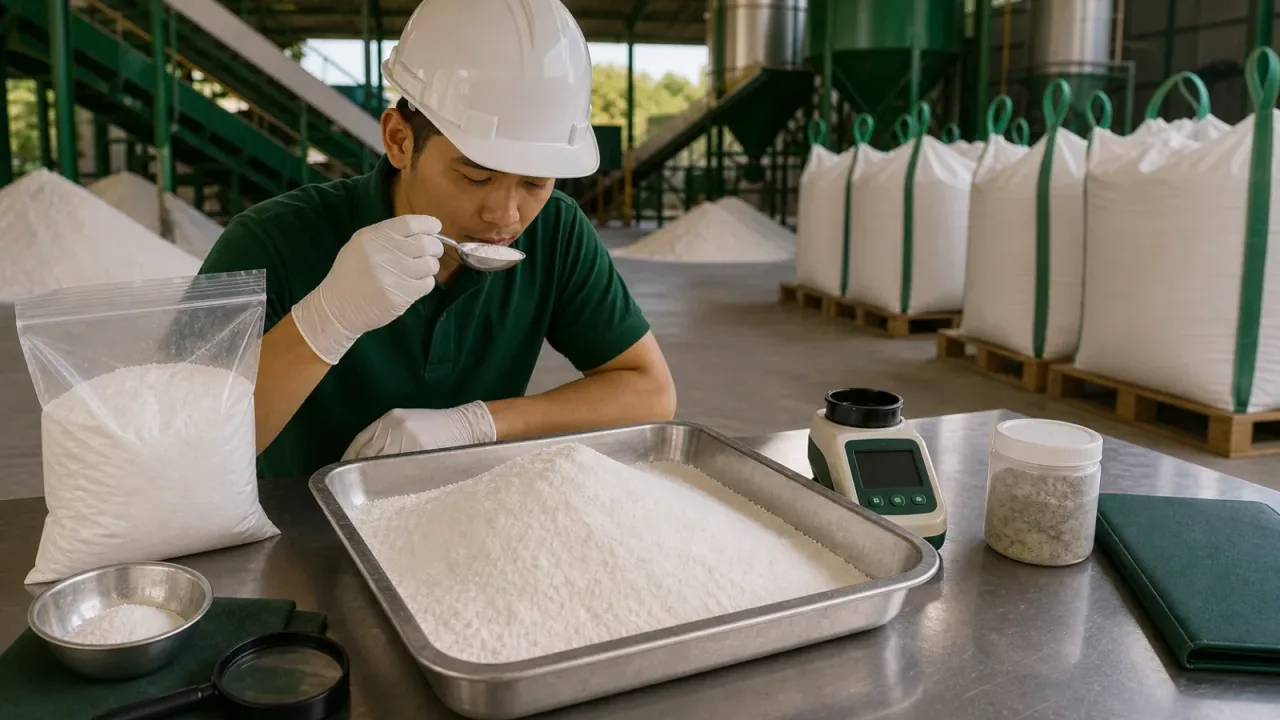
Maintaining the quality standards of dried cassava pulp as a primary energy raw material in the animal feed industry does not rely solely on laboratory chemical analysis; it must begin with an accurate sensory evaluation system to monitor biochemical changes at an early stage. Understanding the mechanisms behind off-odors and the physical changes in fungi will enable feed mills to effectively prevent the risks of mycotoxin contamination and nutritional loss, which is fundamental to reducing production costs and maintaining the safety of the animal feed supply chain.
1. The Importance of Dried Cassable Pulp and Economic Quality Control
In the animal feed production industry, dried cassava pulp is considered a crucial carbohydrate source due to its cost-effectiveness relative to the energy provided. However, the primary challenge faced by Quality Control (QC) officers in feed mills is the variation in raw material quality, which depends heavily on storage processes.
Economic risks arise not only from the loss of raw material due to spoilage but also from hidden costs, such as the reduction in Digestible Energy (DE), leading to nutrient imbalance in feed formulas, and the risk of animals ingesting toxins, which can result in reduced Average Daily Gain (ADG) or livestock mortality. Therefore, using sensory perception to detect odors and physical characteristics serves as the most critical first line of defense for screening raw materials immediately upon arrival at the factory.
2. Biochemical Mechanisms of Spoilage: When Moisture Becomes a Microbial Driver
The spoilage of dried cassava pulp is rooted in biochemical processes triggered by physical factors, with the primary drivers being as follows:
- Moisture Content and Water Activity (aw): Even if the overall moisture content is low, if the $a_w$ at certain points within the raw material pile exceeds a certain threshold (typically if $a_w$ > 0.60-0.70), it creates an environment conducive to fungal spore germination and bacterial growth.
- Fermentation: When moisture and oxygen levels within bags or silos are inappropriate, microorganisms begin the decomposition of carbohydrates, leading to changes in pH levels and the accumulation of organic acids, which is the cause of sour odors.
- External Factors: These are difficult to control in warehouses; for instance, rising temperatures accelerate microbial metabolic rates, while high Relative Humidity (RH) in storage makes it harder for moisture to evaporate from the raw material, resulting in heat accumulation within the pile (hot spots).
3. Classification of "Off-Odors" for Preliminary Diagnosis
Olfactory identification is a vital skill for QC officers to identify the type of problem occurring with the raw material. Odor characteristics can be categorized based on their microbiological causes as follows:
| Odor Characteristic | Technical Indicator | Possible Cause |
| Sour/Acidic | Increase in organic acids within the system | Activity of Lactic Acid Bacteria or uncontrolled fermentation |
| Musty/Earthy | Accumulation of Volatile Organic Compounds (VOCs) from fungi | Early-stage fungal growth |
| Putrid/Rotten | Decomposition of protein and nitrogen structures | Activity of anaerobic bacteria |
| Chemical/Pungent | Accumulation of secondary metabolites | Production of metabolites from specific fungal species |
4. Physical Inspection: Identifying Fungi and Physical Characteristics (Visual & Physical Inspection)
In addition to olfaction, visual inspection helps confirm the severity of contamination more accurately:
4.1 Color Discoloration
The discoloration of cassava pulp serves as an indicator of the diversity of fungal species:
- White or Grey spots: Often represent the early stage of invasion by filamentous fungi.
- Black, Green, or Yellow spots: Indicate sporulation of dangerous fungal groups, such as AsAspergillus spp., which pose a high risk of toxin production.
4.2 Texture Changes
Increased moisture during storage leads to abnormal physical characteristics, including:
- Clumping/Caking: Caused by high moisture levels that make cassava particles adhere to one another, making flowability difficult during the animal feed production process.
- Sliminess: Moisture accumulation in poorly ventilated areas can lead to a slimy or mucilaginous texture, which is a signal of severe spoilage.
- Heat Accumulation: Inspecting the temperature within raw material piles or bags; if the temperature is significantly higher than the ambient temperature, it indicates that biochemical reactions are occurring internally.
5. The Hidden Threat: Mycotoxins
The most important precaution for animal nutritionists is: "Invisible fungi does not mean the absence of toxins."
When fungi grow and reach the sporulation stage, they secrete toxins known as Mycotoxins into the raw material. The groups of toxins that require extra vigilance in cassava pulp are Aflatoxin and Ochratoxin. These toxins are highly stable; they are not destroyed by heat during the pelleting process and cannot be removed through washing.
Therefore, sensory evaluation is merely a tool for "Screening." In technical terms, for "Safety Confirmation," factories must utilize laboratory analysis and verify Certificates of Analysis (COA) to check toxin levels at the microgram per kilogram level.
6. Impact on Animal Nutrition & Health
Allowing degraded raw materials to enter the production process results in a chain reaction, as follows:
- Loss of Nutritional Value: Fermentation and decomposition processes reduce Digestible Energy (DE) and macronutrients, causing the calculated feed formulas to underperform against their targets.
- Reduced Palatability: Off-odors trigger feed refusal in animals, directly impacting growth rates.
- Mycotoxicosis: Chronic exposure to toxins can affect the immune system, liver function, and reproductive efficiency. In cases of high contamination, it may lead to acute toxicity.
7. Prevention & Quality Control Standards
To maintain the highest standards in animal feed production, factories should adhere to the following guidelines:
1. Drying Process Control: Consistently control the moisture content of cassava pulp to be below the standard threshold to reduce $a_w$ at the source.
2. FIFO Warehouse Management: Implement the First-In, First-Out principle to prevent the accumulation of old raw materials at risk of degradation, and ensure warehouse ventilation systems are managed to control relative humidity.
3. Integrated Use of Tools and Sensory Evaluation: Alongside smelling and visual inspection, moisture meters should be used regularly, and random sampling for mycotoxin testing in laboratories should be conducted according to standard cycles.
If you are looking for high-standard dried cassava pulp with complete laboratory analysis and COA to ensure the safety of your animal feed, please contact our team of experts to request product specifications or samples for testing in your laboratory immediately.
Sources
- Thai Tapioca Starch Association - Tapioca Production - https://www.thaitapiocastarch.org/en/information/statistics/tapioca_production - ใช้ยืนยันภาพรวมผลผลิตมันสำปะหลังไทยและบริบท supply ของอุตสาหกรรม
- Thai Tapioca Starch Association - Export Tapioca Products - https://www.thaitapiocastarch.org/en/information/statistics/export_tapioca_products - ใช้ยืนยันสถิติส่งออกผลิตภัณฑ์มันสำปะหลัง รวมถึงหมวด Pulp
- Thai Tapioca Starch Association - Tapioca Starch Processing - https://thaitapiocastarch.org/en/information/learning_industry/tapioca_starch_processing - ใช้อธิบายกระบวนการผลิตแป้งมันและที่มาของผลพลอยได้จากโรงงานแป้งมัน
- ACFS / TAS 8803-2561 - มาตรฐานสินค้าเกษตร กากมันสำปะหลัง - https://www.opsmoac.go.th/udonthani-dwl-files-471491791858 - ใช้อ้างอิงนิยามกากมันสำปะหลังแห้ง/ผง/อัดเม็ด และข้อกำหนดพื้นฐาน เช่น ไม่พบเชื้อราหรือสิ่งแปลกปลอมที่มองเห็นได้
- FAO - Roots, tubers, plantains and bananas in animal feeding - https://www.fao.org/4/T0554E/T0554E05.htm - ใช้ยืนยันประเด็นความชื้น สิ่งปลอมปน เถ้า ทราย และความเสี่ยง aflatoxin ในสินค้า cassava/feed
- FAO - Thailand Feed and Feed Ingredient Standards - https://www.fao.org/fileadmin/user_upload/affris/docs/standard/Thailand_Feed_and_Feed_Ingredient_Standards.pdf - ใช้เป็นตัวอย่างโครงสร้างค่าวิเคราะห์วัตถุดิบอาหารสัตว์ เช่น moisture, protein, fiber, ash
- DLD - การตรวจอะฟลาทอกซินในวัตถุดิบอาหารสัตว์ - https://qcontrol.dld.go.th/images/Prototype/knowledge/analysis/2565/13.pdf - ใช้สนับสนุนหัวข้อ aflatoxin, วิธีวิเคราะห์ และเหตุผลที่ควรตรวจเป็นรอบเมื่อมีความเสี่ยง

Author information
Sri Thong Admin
B2B dried cassava pulp content specialist
Affiliation
SRITHONG PRODUCTTAPIOCA COMPANY LIMITED