Cassava pulp moisture 11-13%: why it matters for bulk buyers
เขียนโดย Sri Thong Admin · เผยแพร่ 2026-07-10 · อัปเดต 2026-06-07
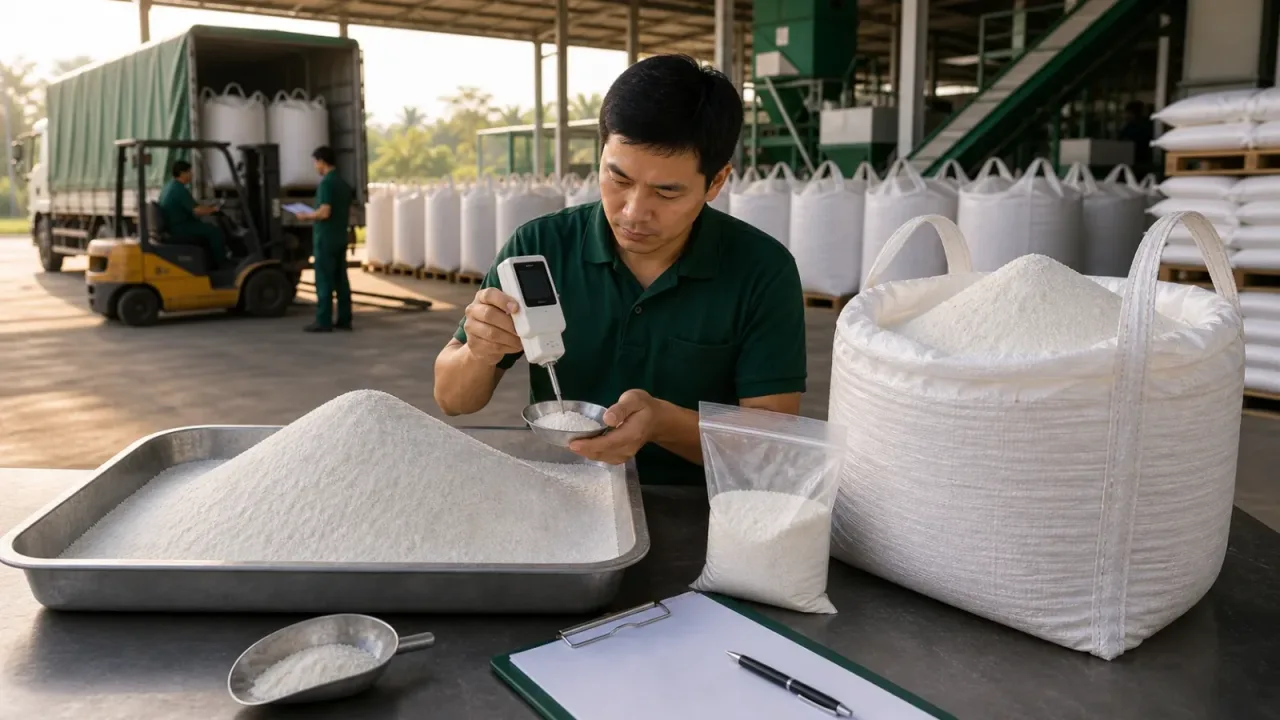
For global feed manufacturers and bulk commodity traders, the moisture content of cassava pulp is not merely a technical specification; it is a fundamental determinant of product stability, nutritional integrity, and total landed cost. Maintaining a strictly controlled moisture range of 11-113% serves as a critical barrier against microbial degradation, ensures the precision of energy-based ration formulations, and optimizes the economic efficiency of international logistics. For procurement professionals, prioritizing this specific moisture standard is a strategic move to mitigate the risks of mycotoxin contamination, prevent product shrinkage during transit, and ensure that the value paid per ton reflects actual nutrient delivery rather than excess water weight.
The Standard of Excellence in Cassava Pulp Procurement
In the complex ecosystem of animal nutrition, cassava pulp serves as a vital carbohydrate and energy source, particularly in formulations for ruminants and monogastric animals. However, the utility of cassava pulp as a commodity is heavily dependent on its physical and chemical consistency. In large-scale international trading, "standard" quality is often a subjective term, but for high-performance feed mills, the 11-13% moisture specification represents the frontier of "optimal" quality.
When procurement teams move beyond looking at the surface-level price and begin analyzing the 11-13% moisture threshold, they are transitioning from reactive buying to strategic supply chain management. This precision in moisture control is the difference between a raw material that acts as a reliable nutritional building block and one that introduces volatility into the production process.
Microbiological Stability: The Science of Preservation
The primary challenge in storing bulk organic matter like cassava pulp is the management of Water Activity ($a_w$). While moisture content refers to the total amount of water present, water activity measures the availability of that water for biological use. There is a direct, scientific correlation between high moisture levels and the acceleration of microbial proliferation.
Preventing Fermentation and Acidification
When moisture levels exceed the 13% threshold, the environment becomes conducive to the growth of yeasts and molds. In bulk storage environments—such as silos or large shipping containers—excess moisture can trigger localized fermentation. This process leads to the production of organic acids, which alters the pH of the material, potentially degrading the starch content and making the ingredient unsuitable for standardized feed recipes.
Mitigating Mycotoxin Risks
Perhaps the most significant risk for B2B buyers is the development of mycotoxins, such as Aflatoxin. Certain fungal species thrive in high-moisture, low-oxygen environments typical of bulked agricultural commodities. Mycotoxin contamination is not only a matter of ingredient loss but a significant food safety risk that can lead to large-scale batch rejections, legal liabilities, and threats to livestock health. By adhering to the 11-13% moisture standard, producers significantly reduce the biological window available for mycotoxigenic fungi to colonize the product.
Nutritional Density and Formulation Precision
For nutritionists at large-scale feed mills, precision is the cornerstone of cost-effective production. Every gram of moisture in a shipment represents a gram of "empty" weight that does not contribute to the animal's nutritional requirements.
The "Hidden Weight" Problem
The concept of Dry Matter (DM) is critical when analyzing the true value of cassava pulp. A shipment with high moisture variability forces nutritionists to constantly adjust their formulations, leading to instability in the final feed product. Consider the following comparison of nutrient density based on moisture levels:
| Parameter | Standard (12% Moisture) | High Moisture (20% Moisture) | Impact of Variance |
| Dry Matter (DM) % | 88% | 80% | 12% reduction in nutrients |
| Nutrient Concentration | Optimized | Diluted | Requires higher volume for same ME |
| Formulation Stability | High | Low | Increased risk of error |
Impact on Energy (ME) and Fiber (NDF/ADHD)
Consistent moisture levels allow for the precise calculation of Metabolizable Energy (ME) and fiber fractions like Neutral Detergent Fiber (NDF) and Acid Detergent Fiber (ADF). When moisture fluctuates, the concentration of these components per unit of weight shifts unpredictably. For a feed mill processing thousands of tons per day, even a 2% fluctuation in moisture can lead to significant deviations in the total energy output of the finished ration, affecting animal performance and profitability.
Logistics and Supply Chain Optimization
The economic benefits of 11-13% moisture extend far beyond the laboratory; they are deeply embedded in the logistics of global trade.
Weight-to-Value Ratio and Transport Costs
In bulk international shipping, freight costs are calculated based on weight. Transporting "excess water" is a direct drain on profitability. When a shipment contains 20% moisture instead of 12%, the buyer is essentially paying for the transport of 8% additional weight that provides zero nutritional value. Over the course of several hundred containers, this "water tax" becomes a massive operational loss.
Physical Properties and Handling
The physical state of the product during sea freight is crucial. High moisture content increases the risk of:
- Caking and Clumping: Moisture facilitates the bonding of particles, making the product difficult to discharge from bulk carriers or trucks.
- Compaction: Heavy, moist material can compact under its own weight during long voyages, leading to difficult handling in the feed mill's intake systems.
- Heat Generation: Excess moisture can contribute to "hot spots" within a cargo hold, further accelerating degradation.
Economic Impact: The Real Cost of Procurement
A common pitfall in commodity procurement is the "Price per Metric Ton" trap. A lower-priced product often hides the true cost of high moisture.
The "Price per Unit of Dry Matter" Analysis
To truly understand the value, procurement officers must analyze the cost relative to the Dry Matter content. A product priced at $200/MT with 12% moisture is significantly cheaper than a product at $190/MT with 20% moisture when evaluated on a DM basis. The latter requires more volume to meet the same nutritional target, increasing both the purchase price and the logistical expense.
Reducing Product Shrinkage and Disputes
Shrinkage—the loss of weight due to evaporation or degradation during transit—is a major source of financial leakage. High-moisture products are prone to significant weight loss as they dry out during long-haul journeys. Furthermore, inconsistent moisture levels are a primary driver of quality disputes, laboratory rejections, and the costly process of settling claims between buyers and suppliers. Maintaining the 11-13% standard acts as a risk management tool, ensuring that what is invoiced is what is delivered.
Conclusion: Strategic Procurement for Global Feed Producers
In conclusion, the 11-13% moisture specification in cassava pulp is a benchmark for quality assurance that serves the interests of all stakeholders in the supply chain. For the producer, it represents controlled, professional manufacturing; for the logistics provider, it ensures stable cargo; and for the feed mill, it provides the nutritional and economic predictability required for large-scale operations.
For global bulk buyers, the strategic recommendation is clear: prioritize the specification over the initial price. By investing in a product with a guaranteed 11-13% moisture range, you are investing in the stability of your formulation, the safety of your livestock, and the long-term efficiency of your supply chain.
แหล่งข้อมูล
- Thai Tapioca Starch Association - Tapioca Production - https://www.thaitapiocastarch.org/en/information/statistics/tapioca_production - ใช้ยืนยันภาพรวมผลผลิตมันสำปะหลังไทยและบริบท supply ของอุตสาหกรรม
- Thai Tapioca Starch Association - Export Tapioca Products - https://www.thaitapiocastarch.org/en/information/statistics/export_tapioca_products - ใช้ยืนยันสถิติส่งออกผลิตภัณฑ์มันสำปะหลัง รวมถึงหมวด Pulp
- Thai Tapioca Starch Association - Tapioca Starch Processing - https://thaitapiocastarch.org/en/information/learning_industry/tapioca_starch_processing - ใช้อธิบายกระบวนการผลิตแป้งมันและที่มาของผลพลอยได้จากโรงงานแป้งมัน
- ACFS / TAS 8803-2561 - มาตรฐานสินค้าเกษตร กากมันสำปะหลัง - https://www.opsmoac.go.th/udonthani-dwl-files-471491791858 - ใช้อ้างอิงนิยามกากมันสำปะหลังแห้ง/ผง/อัดเม็ด และข้อกำหนดพื้นฐาน เช่น ไม่พบเชื้อราหรือสิ่งแปลกปลอมที่มองเห็นได้
- Feedipedia - Cassava peels, cassava pomace and other cassava by-products - https://www.feedipedia.org/node/526 - ใช้เป็นฐานข้อมูลคุณค่าทางอาหารและข้อจำกัดของ cassava by-products ในอาหารสัตว์
- FAO - Processing cassava for animal feeds - https://www.fao.org/4/x5458e/x5458e0d.htm - ใช้อธิบาย cassava/tapioca products ในอาหารสัตว์และรูปแบบสินค้า เช่น chips/pellets
- FAO - A review of ruminant responses to cassava-based diets - https://www.fao.org/4/x5458e/x5458e07.htm - ใช้ยืนยันว่าการใช้ในสัตว์เคี้ยวเอื้องต้องจัดสมดุลโปรตีน แร่ธาตุ วิตามิน และอาหารหยาบ
- JIRCAS - Cassava pulp is suitable as beef cattle feed - https://www.jircas.go.jp/en/publication/research_results/2018_a02 - ใช้เป็นข้อมูลอ้างอิงสำหรับกลุ่มฟาร์มโคและโคขุน โดยเน้นคุณค่าทางอาหาร ความสม่ำเสมอ และข้อควรจัดการ

ข้อมูลผู้เขียน
Sri Thong Admin
ผู้ดูแลเนื้อหากากมันสำปะหลังตากแห้งสำหรับผู้ซื้อ B2B
หน่วยงาน
บริษัท ศรีทอง โปรดัคท์ทาปิโอก้า จำกัด